Why Circadian Health is the New Longevity Frontier
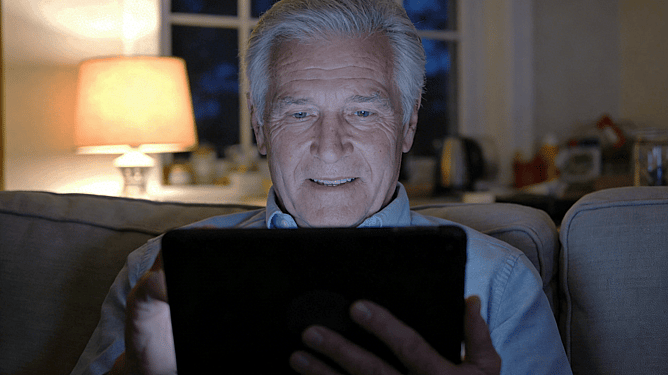
Here is a scary fact: People aged 45 to 64 are spending 40% more time looking at screens than they did three years ago. By the year 2030, about one out of every six people in the world will be approaching age 65 or older. This group is called the "Silver Surfers." They are using tablets and phones more than ever, but their bodies are paying a high price for it.
The Main Problem: Light from screens at night can stop the body from making Melatonin. In older adults, this "sleep hormone" can drop by 85%. This makes your internal body clock act decades older than you really are.
As we often say on the Pushing the Limits podcast, living a long life is not just about adding years. It is about protecting the natural rhythm that repairs your body. If you do not manage the light around you, you are leaving your health to luck.
Your Eyes and the "Blue Light Trap"
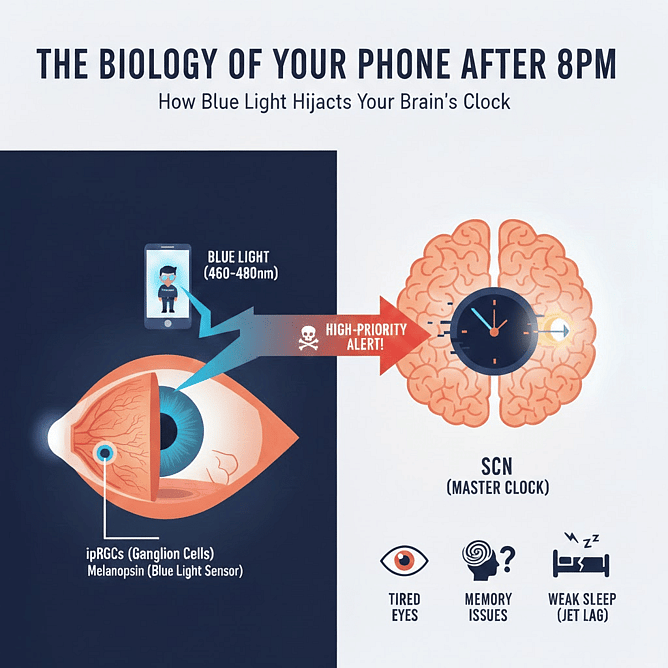
To understand why your phone is a danger after 8 PM, you need to know about ipRGCs.
The ipRGCs are like the "Light Watchmen" of your eyes. While your other eye cells help you see images, these watchmen only care about brightness . Specifically, they contain a photopigment called Melanopsin, which is hypersensitive to blue light (460-480nm). When these watchmen see blue light, they send a high-priority signal to the Suprachiasmatic Nucleus (SCN)—the brain’s master clock—telling it that the sun is high in the sky, even if you are just scrolling through Facebook in bed.
This creates a big mistake in your Circadian Biology (your body's clock). As we get older, our sleep becomes "weaker." we wake up more easily and get less deep sleep. When you add blue light to the mix, you aren't just staying up late. You are giving yourself "jet lag" while sitting on your couch.
This stops your body from fixing itself at night. It leads to tired eyes and can even hurt your memory over time.
How ALAN Rewrites Your Longevity
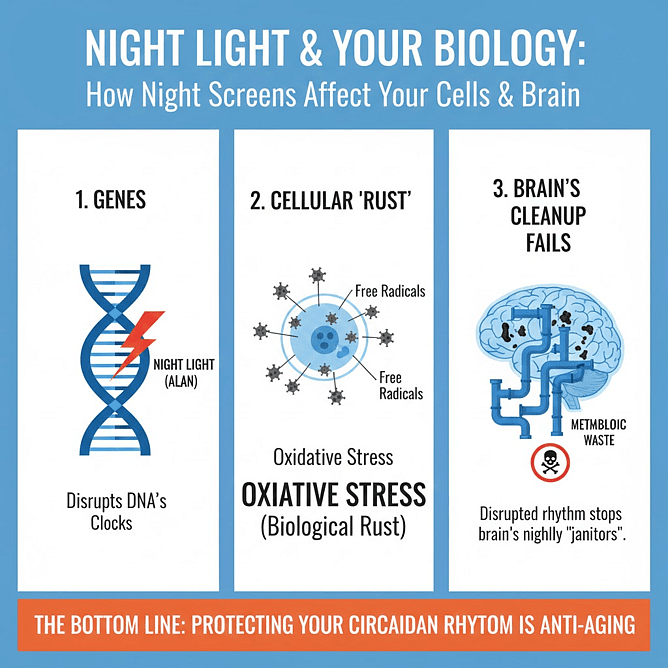
It is a common misconception that light only affects your eyes. In reality, light is a drug that alters your gene expression. Within every cell in your body, there are "Clock Genes" known as CLOCK and PER.
In a healthy environment, these genes oscillate in a perfect 24-hour symphony. However, Nighttime Artificial Light (ALAN) acts as a disruptor, forcing these genes to "misfire." Research comparing night workers shows that those with high nighttime light exposure have higher markers of Oxidative Stress —think of this as the "biological rust" that accumulates in your cells.
When your PER genes are suppressed by nighttime blue light, your Glymphatic System—which is essentially the brain's nightly janitorial service—cannot effectively flush out metabolic waste. This lack of "brain washing" is a primary driver of neurodegenerative risks. For the aging high-performer, protecting the circadian rhythm isn't a luxury; it's a foundational defense against the erosion of time.
The Red Lens Revolution
While many turn to "Blue Light Blocking" glasses, most clear or yellow lenses on the market only filter 10-20% of the harmful spectrum. They are the equivalent of putting a small umbrella in a hurricane. If you want to truly protect your brain, you need glasses that truly protect your sleep.standard vs. Gloojo blue light blockers
The Night Ease™ technology uses a specialized red-orange tint designed to create a "Simulated Darkness."
Even if your lights are on and your screen is bright, your ipRGCs (those light watchmen) are convinced it is pitch black. This allows the natural cascade of melatonin to begin exactly when it should—approximately two hours before sleep.
The Long Life Plan:
Manage Your Light Fixing your light is a three-step plan. You should follow it just like you follow a diet or a workout.
1.Morning Sun: Get 10 to 15 minutes of direct sunlight within 30 minutes of waking up. This "anchors" your body clock for the day.
2.Evening Switch: When the sun goes down, use dim, warm lamps. Avoid the bright, "cool white" LED ceiling lights.
3.The Night Shield: Two hours before you want to sleep, put on your Nighttime sleep glasses . This creates a "safety bubble" for your brain. You can still use your devices, but your body can still repair itself.
Conclusion: Guard Your Health
We live in a world where the sun never truly sets because of our lights. But our bodies were made for a world of campfires and stars. To stay healthy in the digital age, we must fix the gap between our old genes and our new screens. Managing your body clock is the most powerful tool you have to live a long life. By blocking the blue light trap, you sleep better and stay strong.
Ready to protect your future? Use the code LisaTamati15 at Gloojo glasses. to get your Night Ease™ Visit: https://gloojo.com/
'Note:If you'd like to learn more about the hands-on experience with Night Ease™ glasses, check out my YouTube channel
References: 1.C. A. Czeisler et al., Suppression of melatonin secretion in some blind patients by exposure to bright light. N Engl. J. Med. 332, 6–11 (1995),
2.M. St Hilaire et al., The spectral sensitivity of human circadian resetting and melatonin suppression to light changes dynamically with light duration. Proc. Natl. Acad. Sci. U.S.A. 119, e2205301119 (2022).
3.Teixeira, K. R. C., Dos Santos, C. P., de Medeiros, L. A., Mendes, J. A., Cunha, T. M., De Angelis, K., Penha-Silva, N., de Oliveira, E. P., & Crispim, C. A. (2019). Night workers have lower levels of antioxidant defenses and higher levels of oxidative stress damage when compared to day workers. Scientific reports, 9(1), 4455. 4.Esquirol Y, et al. Shift work and metabolic syndrome: respective impacts of job strain, physical activity, and dietary rhythms. Chronobiol Int. 2009;26:544–559. doi: 10.1080/07420520902821176.