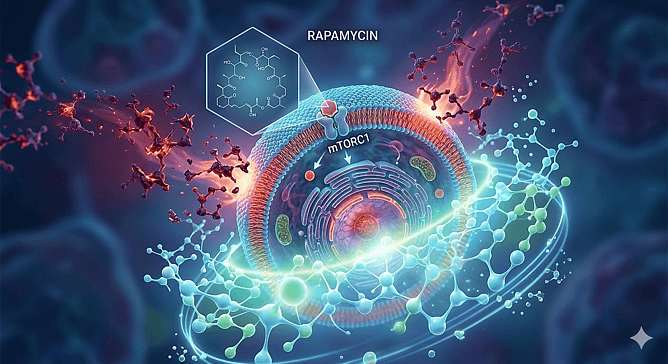
Pearl Trial Results
For years, Rapamycin has occupied a fascinating—and controversial—position in longevity medicine.
On one side, the preclinical data has been extraordinary: lifespan extension across multiple species, improvements in cardiovascular function, reduced cancer incidence, and enhanced resilience in ageing systems.
On the other side, human evidence has remained limited—until now.
The release of the PEARL trial marks a turning point. But its real significance isn’t just about rapamycin itself.
It’s about what it reveals regarding how aging interventions actually work in the human body—and where foundational system support becomes critical.
The PEARL Trial: A Breakthrough With Important Implications
The Participatory Evaluation of Ageing with Rapamycin for Longevity (PEARL) trial is one of the first randomized controlled trials to evaluate low-dose, intermittent rapamycin in healthy older adults.
Participants received either 5 mg or 10 mg weekly over 48 weeks.
The key outcomes:
Increased lean muscle mass
Improved bone mineral density
These findings directly address two of the most important drivers of ageing:
Sarcopenia (muscle loss)
Bone fragility
Both are strongly associated with frailty, loss of independence, and mortality.
But Here’s the Critical Insight
While rapamycin targets the mTOR signalling pathway, aging itself is not controlled by a single pathway.
The effectiveness of any longevity intervention depends on the biological environment it operates within.
That environment is shaped by:
Immune system function
Inflammatory balance
Cellular signalling integrity
Gut–immune interactions
This is where most longevity conversations fall short—and where Rejuvenate Pro becomes highly relevant.
Longevity Is a Systems Problem, Not a Single Intervention
The emerging science in 2026 makes one thing clear:
Targeting aging pathways is only part of the equation.
Supporting the systems that regulate those pathways is equally essential.
Recent research in Science Immunology and Frontiers in Immunology highlights how aging is deeply influenced by:
Immune system dysregulation
Chronic low-grade inflammation
Breakdown in cellular communication
These processes affect how the body responds to stress, repair signals, and therapeutic interventions.
Where Rejuvenate Pro Fits Into This New Model
Rejuvenate Pro is designed to support the core biological systems that underpin healthy ageing.
It is built around clinically researched ingredients including:
Immunel®
Immune Defense Protein (IDP) from Quantec
These ingredients have over 15 years of research supporting their role in:
Immune Modulation and Resilience
Supporting both innate and adaptive immune function
Enhancing immune responsiveness
Helping regulate inflammatory signalling
Importantly, this is not about overstimulation.
It’s about restoring balance and functional capacity within the immune system.
Why This Matters in the Context of Rapamycin
Rapamycin works by influencing cellular growth, repair, and stress response pathways.
But those processes are tightly connected to:
Immune signalling
Inflammatory status
Tissue repair mechanisms
This means:
The effectiveness and tolerability of pathway-targeting interventions may depend on the stability of these underlying systems.
Rejuvenate Pro supports exactly these foundational layers.
A Key Area of Alignment: Immune Responsiveness
One of the most important findings in research on Immune Defense Protein (IDP) is its ability to support functional immune responsiveness in humans, including improved antibody responses.
Why is this important?
Because ageing is characterised by:
Reduced responsiveness to challenges
Slower recovery
Increased inflammatory noise
Supporting immune responsiveness helps maintain:
Efficient signalling
Appropriate immune reactions
Better overall system coordination
The Gut–Immune Connection: Expanding the Picture
A recent study published on bioRxiv showed that fermented foods can:
Increase gut microbial diversity
Reduce inflammatory markers
This reinforces a key principle:
The Gut microbiome plays a central role in regulating systemic health.
Rejuvenate Pro contributes to this axis by supporting:
Gut barrier integrity
Mucosal immune defense
Microbial balance
This places it within one of the most important control systems in ageing biology.
The New Longevity Framework
The science emerging in 2026 points to a more integrated model of aging intervention:
1. Target Core Pathways
Rapamycin → mTOR, autophagy, cellular regulation
2. Support the Biological Environment
Rejuvenate Pro → immune balance, inflammation control, system resilience
Why This Integration Matters
Focusing only on pathway-targeting interventions misses a critical reality:
Biology is interconnected.
No pathway operates in isolation.
And no intervention works optimally in a compromised system.
What This Means Moving Forward
The PEARL trial is a milestone—but it also highlights a broader truth:
Ageing can be influenced pharmacologically
But outcomes depend on system-wide function
This creates a clear role for scientifically grounded formulations like Rejuvenate Pro:
Supporting the systems that regulate inflammation, immunity, and resilience
Helping create the conditions where longevity interventions can perform effectively
Final Takeaway
The future of longevity is not about choosing between:
Pharmaceuticals
Nutrition
Immune support
It’s about combining them intelligently.
Rapamycin shows us we can target aging pathways
Emerging research explains how systems break down with age
And Rejuvenate Pro fits into this landscape by supporting the biological foundation those interventions depend on
As longevity science advances, one thing is becoming clear:
The interventions that succeed will not be the ones that act alone—
but the ones that work in harmony with the body’s underlying systems.