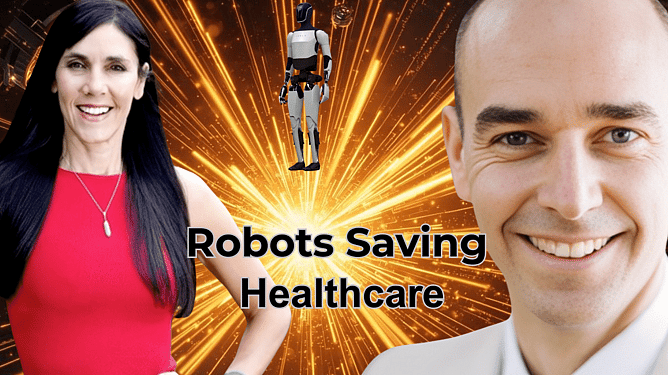
The following is an expanded reflection on a conversation with Cern about the future of Physical Ai in Healthcare
I recently sat down with Cern Basher for a conversation that cut through the AI hype to something far more urgent: the crisis in caregiving that's already here — and the robots that might be our only way through it.
Cern opened with a question that lands differently when you've lived it: "Do you know someone caring for a disabled child… or sitting beside an aging parent, watching them fade a little more each day? Do you know what that kind of love costs — in time, in sleep, in pieces of yourself quietly given away?"
I do know. I've been there. And here's what most people don't understand until they're in it: the math doesn't work. The need for care is exploding. The number of hands to give it is not. Every day, the gap widens.
Watch our full conversation: [Robots Saving Healthcare with Cern Basher](https://www.youtube.com/watch?v=QM0TedNHsxA)
This Is Already Breaking
"We are asking more of caregivers than any system can sustain," Cern wrote. "And it's breaking (already broken in many places on Earth)."
He's right. I've seen it in New Zealand's aged care facilities. I've seen it in the faces of family members juggling full-time work with full-time care. The system isn't strained — it's structurally inadequate. And demographic trends make this a mathematical certainty, not a temporary shortage.
The World Health Organization projects a global shortfall of 10 million healthcare workers by 2030. That's not a staffing problem. That's a civilizational problem.
The Cost I Know Intimately
For 10 years, I've been the 24/7 monitoring system, the lift-and-transfer mechanism, the medication reminder, the fall detection sensor, the emotional support interface.
My mother's life has been in my hands every single day since her aneurysm at 74 — when they told us she'd have no quality of life, and we proved them wrong.
But the cost? I know it intimately.
The sleep that never comes deep enough. The hypervigilance that keeps you awake even when you should be resting. The bone-deep exhaustion of being the failsafe for another human being's existence. Watching someone you love struggle to do what was once effortless. The guilt when you snap because you're running on fumes. The terror that a single mistake — one missed medication, one fall you don't catch, one moment of inattention — could end everything.
I've given pieces of myself I didn't know I had. And I'm one of the "lucky" ones — I had the health background, the resources, the determination. Most caregivers don't.
The world asks us to be superhuman. To sustain impossible vigilance indefinitely. To pour from cups that ran empty years ago. And when we break — because we do break — the system shrugs. "Family care," they call it, as if that makes it sustainable.
Robots Are Not the Story. People Are.
Here's where Cern and I found immediate alignment. The conversation about healthcare robotics usually devolves into tech fetishism — look at this shiny humanoid, isn't it cool? That misses the point entirely.
"Robots are not the story," Cern argued. "People are. Robots are simply the tool that lets us show up better for each other."
This reframing matters. Physical AI isn't about replacing human connection. It's about removing the barriers that prevent human connection — the physical exhaustion, the time constraints, the repetitive labor that consumes caregivers and leaves them too depleted for actual care.
My solo deep dive on physical AI: [The Robots Are Already Here](https://youtu.be/kXvvyYE6oE0)
What Physical AI Actually Does
Cern laid out the practical reality:
- Lift and carry — Physical assistance that prevents caregiver injury
- Monitor — Continuous observation that catches deterioration early
- Assist — Task completion that frees human attention for actual presence
The goal isn't robot caregivers. It's human caregivers with robot support — so that "a mother can rest... a nurse can pause and truly see a patient... care becomes human again."
This is what I call physical AI — AI that operates in the physical world, not just the digital one. And it's arriving faster than most people realize
Tesla Optimus and the Terafab Connection
In our conversation, Cern connected the dots between Tesla's Optimus humanoid and Elon's broader Terafab vision. This isn't just about making robots. It's about making robots at scale — manufacturing capability that can actually meet the scope of the problem.
Tesla's approach to robot learning is particularly relevant here. Fleet learning — where every robot's experience improves the entire network — creates exponential capability growth. The first thousand Optimus units will be clumsy. The millionth will be competent. The hundred millionth will be genuinely capable.
Cern's point: "Without help, something unthinkable becomes normal: A world where millions don't receive the care they need — not because we don't care… but because we can't keep up."
The Terafab infrastructure — the one-terawatt AI compute facility Tesla is building — is what enables this at scale. The robots are coming not because they're cool, but because the math demands them.
Why New Zealand Should Lead
In my solo video, I made the case that New Zealand is uniquely positioned to lead in healthcare robotics adoption. Here's why:
Small scale, high need — Our aged care sector is concentrated enough to pilot at scale, dispersed enough to test real-world deployment challenges.
Regulatory agility — Our MedSafe framework can move faster than FDA or EMA processes. We can establish safety standards and data collection protocols that become global templates.
Cultural fit — New Zealand's ethos of practical innovation aligns with physical AI development. We're not looking for perfect solutions. We're looking for solutions that work.
Cern's response to this framing: compassion at scale. The goal isn't man versus machine. It's using machines to extend human compassion to everyone who needs it — not just those who can afford private care or have family nearby.
The Investment Angle
For PTL Signal readers, there's a portfolio implication here. Physical AI in healthcare isn't science fiction. It's infrastructure deployment with predictable timelines:
- Hardware manufacturers — The companies actually building these systems (Tesla, but also Figure AI, Agility Robotics and others)
- Sensor and compute providers — The infrastructure that makes autonomy possible
- Healthcare integrators — The systems that deploy and maintain robot fleets
- Data platforms — The networks that enable fleet learning across facilities
The deflationary impact of physical AI on healthcare costs could be massive. A robot that costs say $50,000 and operates 20 hours a day replaces multiple shifts of human labor at a fraction of the cost — not to eliminate jobs, but to extend care to people who currently receive none.
Cern ended his thread with this: "This is the choice in front of us. It's not man vs. machine. But compassion… at scale."
I agree. The question isn't whether we want robots in healthcare. The question is whether we want millions of people to go without care because we refused to use the tools available.
For me, this isn't theoretical. I would give anything — anything — to have had even a fraction of the physical support that robots could provide during these 10 years. To offload the crushing physical labour so I have the energy to actually be with her — to talk, to laugh, to hold her hand without my mind racing through the next 20 tasks.
The future isn't robot OR human. It's robot enabling human. It's technology carrying the load so love doesn't have to carry everything alone.
Because right now? We're losing. Caregivers are burning out, aging parents are suffering, and the gap between need and capacity widens every day.
I've lived inside that gap. I know what it costs. Robots aren't the story. But they could be the tool that finally lets the story be about care again — not just survival.
The robots are coming. The only question is how quickly we deploy them, and how thoughtfully we integrate them into systems that remain fundamentally human.
This is why I cover physical AI. Not because it's cool — though it is — but because it's necessary. The math doesn't work without it. And behind that math are real people, waiting.
Watch the conversation:
- [Robots Saving Healthcare with Cern Basher](https://www.youtube.com/watch?v=QM0TedNHsxA)
- [Physical AI: The Robots Are Already Here](https://youtu.be/kXvvyYE6oE0)
Lisa Tamati covers the intersection of health, technology, and markets at PTLsignal.com. Follow me on X at [@lisaytamati](https://x.com/lisaytamati). Follow Cern Basher at [@CernBasher](https://x.com/CernBasher).
This post is an expanded reflection on a public X conversation between Lisa Tamati and Cern Basher, reproduced with permission.