by Lisa Tamati
Let me start by being honest about the most common pushback we get — because it's a fair question and it deserves a proper answer.
"Niacinamide is the slowest, least effective NAD+ precursor. NR is faster. NMN is one step closer to NAD+ in the biosynthesis pathway. Why on earth would you build a formula around niacinamide when better options exist?"
This is not a fringe position. Clinicians with decades of IV NAD experience rank NR above NMN above niacinamide for speed of NAD+ elevation. The entire NAD+ supplement market has been built on this hierarchy. And in isolation — in a young, healthy cell with fully functioning enzymatic machinery — the speed argument is technically correct.
But here's the problem: none of us are young, healthy cells. And the question the industry keeps answering is the wrong question entirely.
Speed of Spike Is the Wrong Metric
The supplement industry has spent the last decade optimising for one thing: how fast can we spike NAD+ levels? NR gets there faster than niacinamide. NMN is one enzymatic step closer to NAD+ than NR — though it's worth noting that NMN must actually be converted back to NR before cellular uptake, which rather undermines the "one step closer" marketing.
But speed of initial spike is not the same as sustained intracellular NAD+ in an aged, inflamed system. And that distinction changes everything.
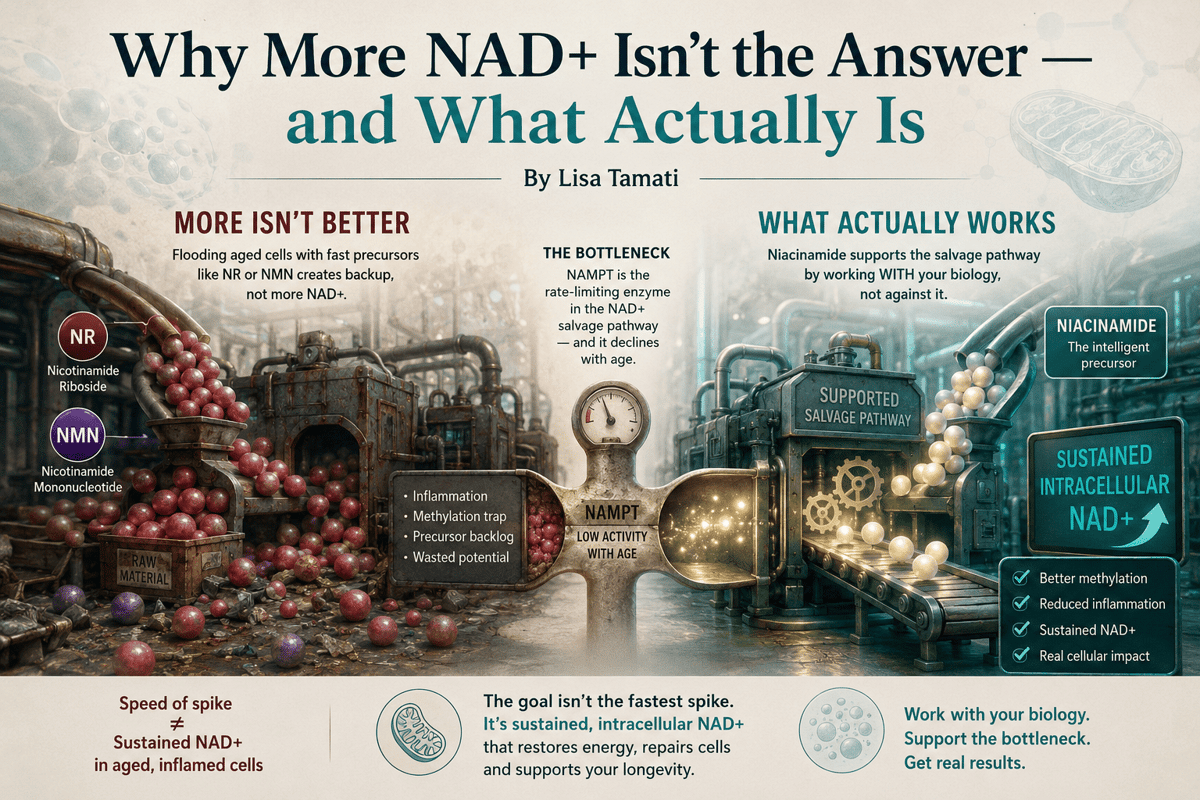
Think about it this way. If the factory machines are broken, pouring more raw material onto the factory floor doesn't increase output. It just creates a pile-up. That's exactly what's happening in aged cells when you flood them with fast-acting precursors without addressing the reasons NAD+ is declining in the first place.
And NAD+ doesn't decline because you run out of raw material. It declines because multiple systems fail at the same time. Understanding those failures — really understanding them — is what led us to build NAD+ Next Gen the way we did.
The Three Failures Driving NAD+ Decline Failure One: The Recycling Machinery Breaks Down
The NAD+ salvage pathway is the primary route your body uses to recycle and maintain its NAD+ pool. The rate-limiting enzyme in this pathway is NAMPT — nicotinamide phosphoribosyltransferase. NAMPT converts niacinamide back into NMN (and then into NAD+), and it's the enzyme that determines how fast the entire recycling loop can run.
NAMPT activity declines significantly with age. This is the real bottleneck — not precursor availability, not conversion speed, but the enzymatic machinery itself. When NAMPT is impaired, it doesn't matter whether you use niacinamide, NR, or NMN. The cell can't process precursors fast enough regardless.
This is the failure that the entire precursor speed debate ignores. If you're choosing between precursors based on how fast they convert, you're optimising the wrong variable. The rate-limiting step isn't the precursor — it's NAMPT.
Failure Two: The Biggest Drain Accelerates
Research from Dr Eduardo Chini's laboratory at the Mayo Clinic has established that an enzyme called CD38 is the dominant consumer of NAD+ in the human body. CD38 degrades more NAD+ than sirtuins and PARPs combined — and its expression increases several-fold with age.
What drives CD38 upward? Chronic inflammatory cytokines from senescent cells. The more systemic inflammation you carry, the more CD38 your body produces, and the faster it burns through your NAD+ pool. As leading researchers in this field have noted, dysfunctional cells consume NAD+ even more voraciously than healthy ones.
This creates a vicious cycle. Inflammation drives CD38. CD38 depletes NAD+. Low NAD+ impairs the cellular repair mechanisms that would otherwise clear senescent cells. Which produces more inflammation. Which drives more CD38.
If you flood NAD+ precursor into this cycle without addressing CD38, you're not restoring youthful NAD+ levels. You're feeding the drain. The precursor enters the cell, gets converted to NAD+ — and CD38 consumes it before your sirtuins or mitochondria ever see it.
Failure Three: The Methylation Trap
When precursors accumulate faster than declining NAMPT can process them — which is exactly what happens with high-dose NMN or NR in an aged system — the cell has a clearance mechanism. An enzyme called NNMT (nicotinamide N-methyltransferase) methylates the excess nicotinamide and excretes it.
The problem is what NNMT uses as fuel: SAMe — S-adenosylmethionine, the universal methyl donor. SAMe is not a minor molecule. Your body depends on it for DNA methylation and repair, epigenetic regulation, neurotransmitter synthesis (serotonin, dopamine, norepinephrine), phase II detoxification, and homocysteine metabolism. Depleting your SAMe pool to clear out excess NAD+ precursors is a significant metabolic cost — and one that most people taking high-dose NMN have no idea they're paying.
The industry's response has been to recommend TMG (trimethylglycine) alongside NMN to replenish methyl donors. Which is the supplement equivalent of taking a second drug to manage the side effects of the first. If your formula requires a companion supplement to avoid creating a new problem, perhaps the formula needs rethinking.
This methylation cost is particularly concerning for individuals with MTHFR polymorphisms — variants that already compromise methylation capacity. Adding a high-dose precursor that further depletes the methyl donor pool is the opposite of personalised medicine.
Why Peter Attia's Scepticism Is Important
Peter Attia — one of the most influential voices in longevity medicine — doesn't take NMN. Doesn't take NR. Doesn't do NAD+ infusions. He classifies NAD+ precursor supplementation as "noise" for geroprotection.
A lot of the NAD+ industry dismisses this as one doctor's opinion. I think that's a mistake. Attia is asking exactly the right question: is NAD+ decline the root cause, or is something else driving it down?
The answer is something else — CD38 overexpression, NNMT diversion, and NAMPT decline. Attia is right that flooding more precursor into a broken system doesn't work. His critique is devastating for single-precursor supplements. But it doesn't apply to a formula that addresses all three failures simultaneously. That's a fundamentally different intervention — and one that has clinical data behind it.
Six Ingredients, Six Pathways, One Integrated System
NAD+ Next Gen wasn't designed to win the precursor speed race. It was designed to restore the entire NAD+ ecosystem — every major mechanism that fails with age, addressed simultaneously. Each of the six ingredients has a defined role within an integrated system. None of them are filler. None of them are there for label decoration. Here's what each one does and why it matters.
Niacinamide — The Precursor (But Not the Whole Story)
Niacinamide is the substrate that enters the salvage pathway via NAMPT. On its own, in an aged cell with declining NAMPT and rampant CD38, it would be exactly what the critics say — a slow, inefficient precursor. But niacinamide was never designed to work alone in this formula. It's the starting material for a pathway that the other five ingredients restore, protect, and amplify.
What niacinamide does bring — and what NMN and NR cannot match — is decades of established human safety data. A prospective Australian clinical trial demonstrated reduced skin cancer incidence with niacinamide supplementation. It avoids the flushing associated with nicotinic acid. It creates no methylation burden for MTHFR-compromised individuals. And it sidesteps the unresolved regulatory questions surrounding NMN — from the FDA's attempted reclassification to independent testing revealing that the majority of NMN products on the market don't meet their own label claims.
Niacinamide isn't in this formula because it was the cheapest option. It's there because when the salvage pathway machinery is restored, a clean, safe precursor delivering sustained NAD+ recycling outperforms a fast precursor creating transient spikes in a broken system.
Quercetin (95%) — The Multi-Pathway Workhorse
No single ingredient in NAD+ Next Gen works across more pathways than quercetin, and the 95% standardisation ensures therapeutic-grade potency rather than the lower concentrations common in commodity supplements.
Quercetin does three critical things in this formula. First, it inhibits CD38 — directly suppressing the dominant enzymatic drain on NAD+. Second, it upregulates NAMPT expression through AMPK-dependent transcription — restoring the rate-limiting enzyme that the entire salvage pathway depends on. Third, it activates both AMPK and SIRT1 signalling, the same cellular maintenance and longevity pathways triggered by caloric restriction and vigorous exercise.
That combination — blocking the drain, restoring the machinery, and activating the longevity pathways that NAD+ fuels — makes quercetin the connective tissue of the entire formula. It bridges the gap between NAD+ production and NAD+ utilisation.
Rutin — The Second NAMPT Activator
Rutin is a Sophora japonica flavonoid that, alongside quercetin, drives NAMPT upregulation through AMPK-dependent mechanisms. The rationale for including two NAMPT activators rather than relying on quercetin alone is robustness — NAMPT decline is the central bottleneck in the entire salvage pathway, and restoring it reliably is the single most important job in the formula. Two compounds acting on the same target through related but distinct mechanisms provide more sustained and resilient enzyme upregulation than a single activator.
Rutin also brings its own independent benefits. It supports vascular integrity, has well-documented anti-inflammatory properties, and provides antioxidant support that complements the formula's broader strategy of reducing the inflammatory environment that drives CD38 overexpression. In a formula built around reducing inflammation to protect NAD+, every ingredient that contributes to that anti-inflammatory architecture earns its place.
Apigenin — The Second CD38 Inhibitor
CD38 expression can increase several-fold with age, driven by multiple inflammatory signalling pathways. A single CD38 inhibitor may provide insufficient suppression in a highly inflamed system — particularly in individuals with significant senescent cell burden, chronic immune activation, or elevated inflammatory markers.
Apigenin provides the second arm of dual CD38 inhibition, working alongside quercetin to deliver more comprehensive suppression of the dominant NADase. This dual approach is deliberate: CD38 is the single largest drain on cellular NAD+, and controlling it robustly is essential. If your formula inhibits CD38 with one compound and that compound's activity is overwhelmed by the degree of inflammatory signalling in an aged system, you lose the battle at the most critical point. Two inhibitors provide a margin of efficacy that a single inhibitor cannot.
Apigenin also has documented effects on cellular senescence pathways and neuroprotective properties, adding further value beyond its primary role as a CD38 inhibitor.
EGCG (Green Tea Extract) — The NNMT Gatekeeper
EGCG directly inhibits NNMT enzymatic activity — the enzyme responsible for the methylation trap described above. This is prevention at source rather than damage control after the fact.
Without NNMT inhibition, excess precursor gets shunted through the methylation pathway, SAMe is depleted, and a cascade of downstream consequences follows: impaired DNA methylation, compromised epigenetic maintenance, reduced neurotransmitter synthesis, slower detoxification, and rising homocysteine. The industry's answer is to bolt on TMG to replace lost methyl donors. EGCG makes that unnecessary by preventing the diversion before it starts.
EGCG also supports mitochondrial biogenesis — the creation of new mitochondria — adding a second critical function to its role in the formula. Mitochondria are both the primary consumers of NAD+ for energy production and the organelles most damaged by the decline in NAD+-dependent repair mechanisms. Supporting mitochondrial renewal while restoring the NAD+ pool creates a synergy that neither intervention achieves alone: more NAD+ to fuel mitochondria, and healthier mitochondria to use it.
Trans-Resveratrol — The SIRT1 Activator and Mitochondrial Amplifier
Resveratrol directly activates SIRT1 — the most-studied longevity sirtuin and the enzyme most dependent on NAD+ as its co-substrate. This creates a deliberate synergistic loop within the formula: the other ingredients restore the NAD+ pool, and resveratrol activates the sirtuin that uses it.
Without sufficient NAD+, SIRT1 can't function — it literally requires NAD+ as a co-factor for every deacetylation reaction it performs. Without SIRT1 activation, restored NAD+ sits underutilised. Resveratrol ensures the NAD+ isn't just produced — it's put to work driving the cellular maintenance, DNA repair, and metabolic regulation that SIRT1 governs.
Resveratrol also activates AMPK signalling and supports mitochondrial biogenesis, working in concert with EGCG to drive mitochondrial renewal from two directions. Together, they ensure the formula doesn't just restore NAD+ levels but also restores the cellular infrastructure that depends on NAD+ to function.
How the Six Pathways Work Together
It's worth stepping back from the individual ingredients to see the system as a whole, because the architecture is the point.
NAMPT is restored (quercetin + rutin), so the salvage pathway functions efficiently again. The precursor (niacinamide) feeds into functioning machinery instead of piling up. The dominant drain (CD38) is suppressed (apigenin + quercetin), so restored NAD+ actually accumulates. The methylation diversion (NNMT) is blocked (EGCG), so there's no precursor overflow burning through SAMe. And the longevity pathways that NAD+ fuels — SIRT1 and AMPK (resveratrol + quercetin), mitochondrial biogenesis (EGCG + resveratrol) — are activated to make use of the restored NAD+ pool.
No single ingredient does this. No precursor-only supplement does this. It's the interaction between all six — the system — that produces the outcome.
Human Data, Not Theory
This whole-system class of approach has published clinical validation. A double-blind, placebo-controlled crossover trial on a similarly architected formula — targeting NAMPT upregulation, CD38 inhibition, and NNMT blockade with niacinamide as precursor — demonstrated measurable outcomes in 28 days: increased NAMPT enzyme levels, increased NAD+, reduced inflammatory markers, reduced glycation, and 1.26 years of biological age reversal.
Not a precursor blood-level spike. Functional, multi-pathway restoration measured in human subjects. The whole-system approach works — and there's human data to prove it.
The Aevum Stack: Why Sequence Is Part of the Strategy
NAD+ Next Gen doesn't exist in isolation. It's Phase 2 of a deliberate sequence.
If CD38 overexpression is driven by inflammatory cytokines from senescent and dysfunctional immune cells, then restoring NAD+ into a highly inflamed system means you're working against the very drain you're trying to control. Even with dual CD38 inhibition, deploying NAD+ restoration into a calmer immune environment produces better results.
Phase 1 of the Aevum Stack — Re:juvenate Pro — targets immunosenescence and immune regulation, reducing the inflammatory cytokine burden that drives CD38 overexpression in the first place. Phase 2 — NAD+ Next Gen — then restores NAD+ biosynthesis into a system where the upstream inflammatory driver has already been addressed.
You wouldn't rebuild an engine while the exhaust system is pumping fumes back into the intake. You fix the exhaust first.
The Mature Position
The NAD+ conversation has been dominated for years by a precursor arms race — who can get NAD+ levels up fastest, who has the most bioavailable molecule, who can show the biggest spike on a blood test. That race has produced a market full of single-ingredient supplements, many of which don't even contain what's on the label, all competing on a metric that misses the point.
The mature, evidence-based position is this: NAD+ decline in ageing isn't a supply problem. It's a systems failure — enzymatic impairment, inflammatory drain, methylation diversion, mitochondrial decline, and reduced longevity signalling, all happening simultaneously. You don't fix a systems problem with a faster precursor. You fix it with a formula that addresses every failure point in the system.
Six ingredients. Six pathways. Each one essential. That's what we built — and the science is clear on why it works. Restore formulation - NAD+ Next Gen will be out soon, join the waiting list to hear when it drops and launch specials: https://shop.lisatamati.com/pages/nad-next-gen-waitlist
Start with Phase 1. NAD+ restoration works best when your immune system isn't working against you. Re:juvenate Pro targets immunosenescence — the age-related immune dysfunction that drives the chronic inflammatory signalling behind CD38 overexpression. By reducing the upstream inflammatory burden first, Phase 2 deploys into a system where restored NAD+ actually accumulates instead of being drained. If you're serious about longevity, the sequence matters: immune foundation first, NAD+ restoration second. Shop Re:juvenate Pro | Join the NAD+ Next Gen Waitlist
Lisa Tamati is co-founder of Aevum Labs and host of the Pushing the Limits podcast.