By Lisa Tamati
I recently had the privilege of speaking at Deloitte's Physical AI TechWeek event alongside Paulo Osorio from Deloitte New Zealand. We were there to talk about something I'm deeply passionate about — why healthcare is the sector where physical AI and robotics can make the most immediate and profound difference, and why New Zealand is uniquely positioned to lead.
This isn't a theoretical conversation for me. I live this every single day.
The Numbers That Should Keep Us Up at Night
Let me ground this in reality. The WHO projects a 10 to 15 million healthcare worker shortage globally by 2030. That's four years away. Sixty percent of the global population already lacks access to essential healthcare services.
Here in New Zealand, the picture is just as confronting. We are the number one country in the OECD for importing overseas nurses — and we're chasing a shrinking pool because every other country is doing the same thing. We currently have around 8,000 vacancies in healthcare that aren't being filled. We need roughly 13,000 more nurses and 5,000 more doctors within the next few years. Age care vacancy rates sit at about 15 percent. And our population over 65 — currently 900,000 — will hit a million by 2029.
We are heading into a crisis. Not might be. Are.
This Is a Human Story, Not a Technology Story
As someone who has been the primary caregiver for my mum — who requires 24/7 care due to severe disability — I know what this crisis looks like at the ground level. I know what it means to try to find in-home care workers and face constant turnover. I know what it's like to only be able to work via a computer because you physically cannot leave the house. I know what it means to sit in an emergency department for 18 hours with your mother near death, waiting to be seen, in a regional area where resources are stretched beyond breaking point.
Nobody who hasn't been a full-time caregiver in an acute setting can truly understand what it takes. The drudgery. The 24/7, no holidays, no breaks reality of it. And in our aged care facilities, the staff — who went into this profession out of genuine passion and care — are burning out because they're being asked to do more than any human can sustainably do.
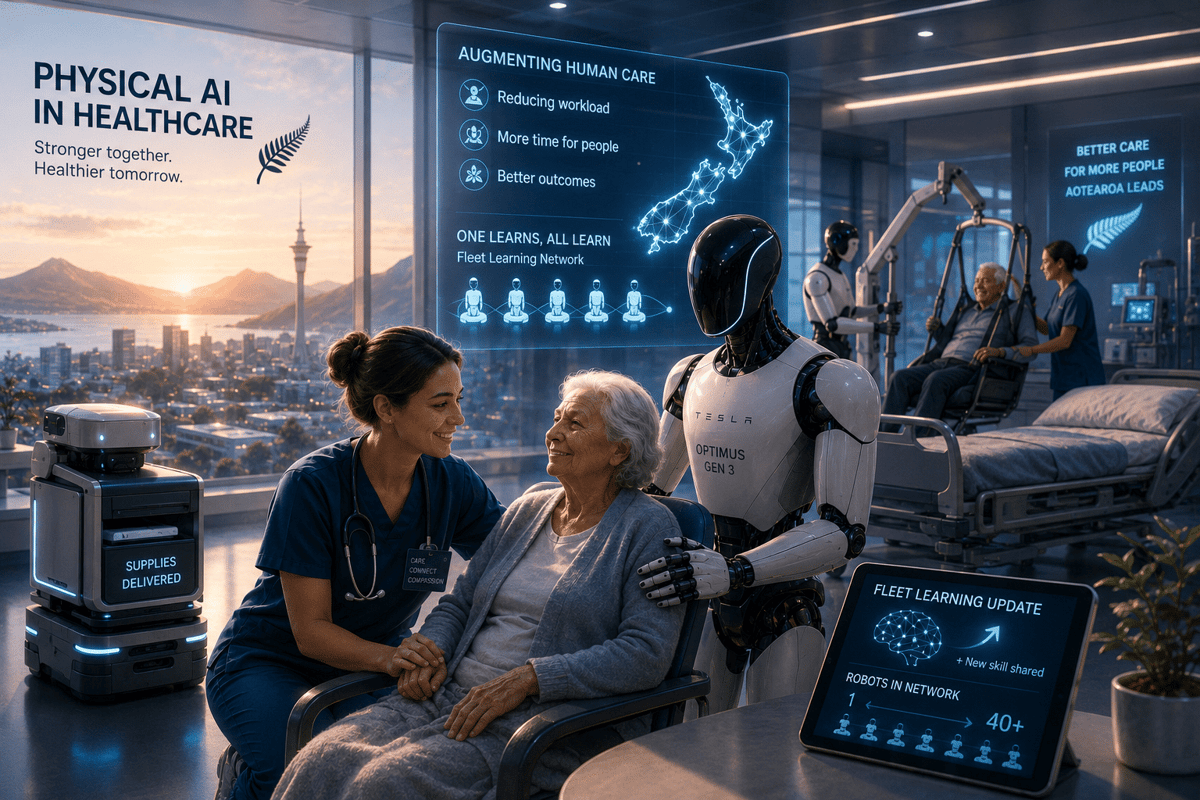
That's why I see the physical AI and robotics story as fundamentally a human story. This is about being able to provide a level of care that we simply cannot provide right now with the resources we have. And critically, this is not about replacing healthcare workers. In other industries, yes, displacement will happen. But in healthcare, this is about augmenting our current staff — giving nurses, doctors, and caregivers the support to actually be present with their patients instead of drowning in repetitive, menial tasks.
The Robots Are Already Here
This isn't five years away. It's happening now.
The Moxy robot is already deployed across 30 hospitals in the United States, saving over a million hours of clinician time. That translates to about half an hour per shift per nurse — time reclaimed from transporting linen, medication, food, and supplies through massive hospital buildings. Hundreds of miles of walking that nurses and orderlies no longer have to do.
At the TechWeek event, we also saw a video presentation from Andromeda Robotics about Abby — a humanoid companion robot already deployed in aged care homes across Australia and the US. Watching elderly residents light up, share stories they don't even tell staff, and experience genuine companionship in facilities where 40 percent of residents might not receive a single visitor in a month — it was heart-wrenching and hopeful in equal measure.
The CEO of Figure recently stated they expect a billion robots worldwide by 2030. Tesla is breaking ground on a factory targeting 10 million Optimus robots. These are being manufactured now. The question isn't whether robots will come to healthcare. They will. The question is who writes the playbook.
Why New Zealand Should Be First in Line
Paulo made a compelling case during our session that New Zealand has several unique advantages that most people overlook.
We have a unified national health system at a manageable scale. We have a comparatively friendly regulatory environment. We've demonstrated — with programmes like Inland Revenue's billion-dollar transformation — that we can execute major change successfully when we have organisational, executive, and political support that lasts through political terms. Healthcare improvement is one of the rare issues with genuine cross-party support.
Health New Zealand's 10-year digital investment plan, released in late 2025, signals real organisational willingness to modernise and build the foundational digital infrastructure that physical AI needs to sit on top of.
And then there's our size. We're small. We're connected. We're not a geopolitical threat or adversarial to anyone on the planet. We're English-speaking. We can coordinate across sectors in ways that larger, more fragmented countries simply cannot. A pilot that works in one hospital can be rolled out nationally far faster here than almost anywhere else in the world.
Back in the 1980s, New Zealand was the first test bed in the world for technologies like EFTPOS and optical fibre. I want to see us reclaim that position.
Fleet Learning Changes Everything
One concept Paulo and I discussed that really deserves attention is fleet learning. When one robot learns to navigate a particular wheelchair, operate a specific hoist, or handle a new task in a ward environment, that knowledge is instantly shared across every robot in the network. The entire fleet levels up simultaneously.
What this means in practical terms is extraordinary. A pilot deployment of around 40 robots could generate the equivalent of 25 years' worth of globally valuable healthcare training data in just six months. You cannot learn this in simulation alone. You need real-world settings, real patients, real hospital corridors and legacy environments.
And here's the thing — these robotics companies need real-world deployment sites as much as we need the robots. That creates a genuine partnership opportunity. New Zealand could offer something these companies are actively looking for, and in return, we build relationships and position ourselves for economic and healthcare benefits that compound over time.
The Hard Part: Getting Ready
Paulo was refreshingly honest about the fact that you can't just unwrap a robot, turn it on, and expect benefits. Robotics readiness covers safety approval pathways, cybersecurity, physical infrastructure, data privacy standards, and talent transformation — and in most organisations, the people responsible for those areas aren't even connected to each other.
His core message: you need a cross-functional task force working the problem together. It's not an IT project. It's not an HR project. It's not a cyber project. It's all of them.
But — and this is important — you don't have to wait until the robots are ready to start getting ready yourself. Organisations can begin now by standardising processes, addressing operational inefficiencies, building governance frameworks, and developing the talent that will supervise and coordinate intelligent systems rather than doing the work manually. That groundwork means when the technology is mature enough for full deployment, you're not starting from zero.
The talent piece is probably the most underrated element. We're going to need people in healthcare organisations who can lead this transition — people who understand both the clinical environment and the technology. Building that human architecture now is critical.
What I Want to See Happen
My vision is straightforward. I want to see a pilot project in New Zealand — in hospitals, aged care facilities, and eventually in-home care settings. We only need around 40 robots to collect enough data to make a real impact and generate globally significant insights.
I want New Zealand to have a seat at the table in shaping the global policies around robotics in healthcare. Because the technology is moving at lightning speed, and the wheels of bureaucracy, regulatory approval, and institutional adoption move slowly. If we don't start these conversations now, years will pass before we're in a position to act, and other countries will have written the rules without us.
And yes — I want the economic win too. As my friend Cern Basher has pointed out, even one robot manufacturing facility could double or triple our GDP. The total addressable market for humanoid robots is the largest of any product ever brought to production. I'd love to see New Zealand benefit from that. But my priority is healthcare first. Better care for our older people. Better support for our nurses and doctors. Better outcomes for families like mine.
We have a window. Let's not waste it.
Lisa Tamati is a functional health practitioner, host of the Pushing the Limits podcast, and advocate for physical AI adoption in New Zealand healthcare. Follow her work at lisatamati.com.