By Lisa Tamati
Here's something that took me a long time to properly understand, and once I did, I couldn't look at the NAD+ shelf the same way again.
Almost every NAD+ product on the market does the same thing. It hands your body more precursor — NMN, NR, niacin, take your pick — on the assumption that if levels are dropping with age, the fix is to pour more in. More substrate, more NAD+, job done.
Except that's not how the biology works. And the strange part is that the science community already knows this. If you read the papers from the people who actually study NAD+ metabolism for a living — the ones whose work the supplement industry quotes when it suits them — they describe the real problem clearly. The market just hasn't caught up to its own source material.
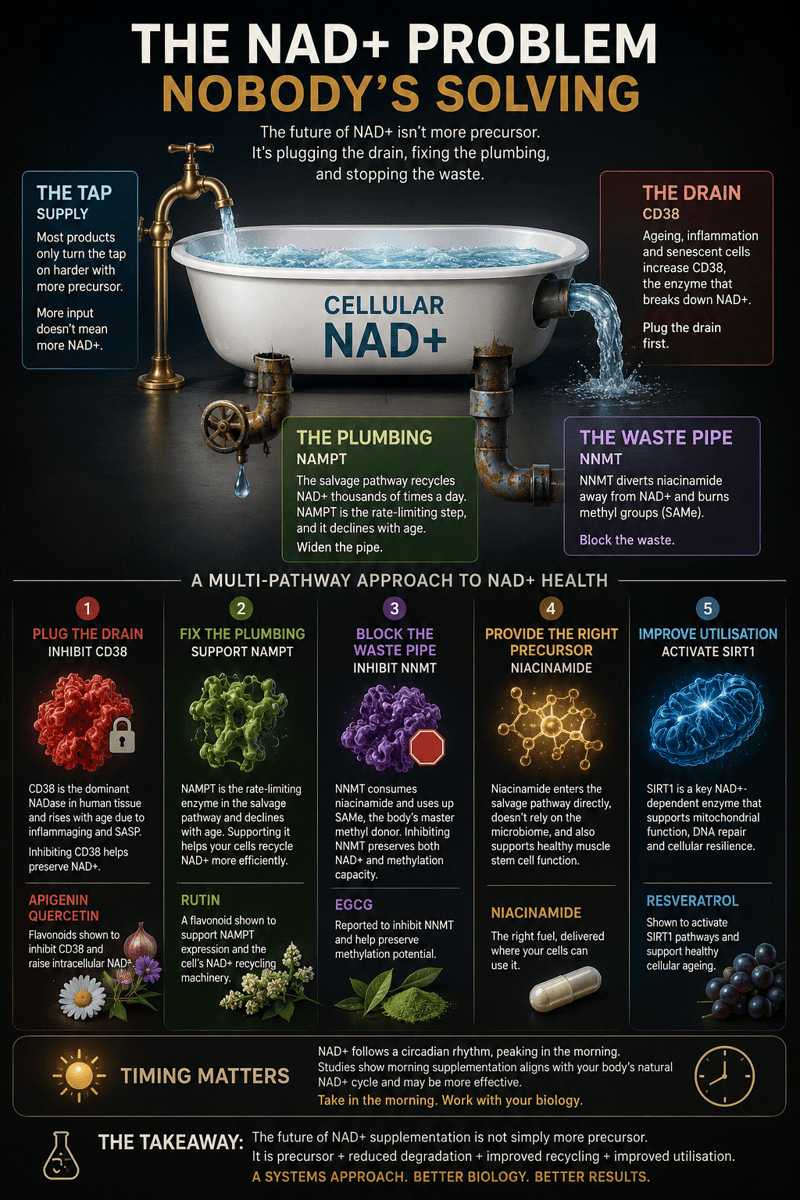
Think of your cellular NAD+ as a bathtub. The popular approach turns the tap on harder. But if the drain is wide open, if the plumbing that's meant to recycle the water has rusted up, and if a side-pipe is quietly siphoning water out before it ever reaches the tub — then turning the tap up is the least efficient thing you can do. You'll burn through expensive precursor and wonder why your levels barely shift.
There are three forces actually driving age-related NAD+ decline. None of them is "you're not taking enough precursor." Let me walk you through each one, because once you see them, the whole category looks different.
One: CD38 — the drain nobody's plugging
If there's a single villain in the NAD+ ageing story, it's an enzyme called CD38.
CD38 is the dominant NADase in human tissue — the main enzyme that chews through NAD+ and breaks it down. And the work that nailed this down came out of Eduardo Chini's lab at the Mayo Clinic. What Chini and his team showed is that CD38 expression and activity climb steadily as we age, and that this rise is not just correlated with the NAD+ drop — it's largely responsible for it. In their animal models, CD38 was required for the age-related NAD+ decline. Knock the enzyme out, and the animals held onto their NAD+ and were protected against the metabolic dysfunction that normally comes with getting older.
So why does CD38 climb with age? This is the part that ties the whole thing together. CD38 is expressed heavily in immune and inflammatory cells, and its expression is driven up by the chronic, low-grade inflammation of ageing — what the field calls inflammageing. It gets worse: senescent cells, those zombie cells that accumulate as we age and refuse to die, secrete a cocktail of inflammatory signals known as the SASP. Chini's group showed that those SASP factors directly induce CD38 in neighbouring healthy cells, ramping up the enzyme and accelerating NAD+ breakdown.
Sit with that for a second, because it reframes everything. The same inflammatory ageing process that you're trying to push back against is the thing throwing the drain wide open. You can pour precursor in all day long, but if CD38 is upregulated and running hot, you're feeding the enzyme as fast as you're feeding the tub. In fact, CD38 is also one of the main enzymes that degrades NMN itself — so the very precursor most people are throwing at the problem can be consumed before it's converted.
This is the single biggest reason a single-precursor NAD+ product underdelivers. It does nothing about the drain.
So what plugs it? You don't need a pharmaceutical CD38 inhibitor sitting in your supplement cupboard. There are natural compounds that do this job, and again, it was Chini's lab — with David Sinclair as a co-author — that characterised them. Two flavonoids, apigenin and quercetin, were shown to directly inhibit CD38 in vitro, raise intracellular NAD+, and in the case of apigenin, improve metabolic markers in obese animals through exactly this mechanism.
That's the logic behind including apigenin and quercetin in a serious NAD+ formula. Not as generic antioxidants thrown in for the label — but as targeted tools to take the foot off the enzyme that's draining the tub in the first place. A formula that understands the biology plugs the drain before it worries about the tap.
Two: NAMPT — the real rate-limiting step
Now to the plumbing.
The vast majority of NAD+ in your cells isn't made fresh from scratch. It's recycled, over and over, through what's called the salvage pathway. Niacinamide gets converted to NMN, NMN to NAD+, NAD+ gets used and broken back down to niacinamide, and round it goes. This loop is how human cells keep the lights on, and it runs thousands of times a day.
The enzyme that governs the speed of that whole loop is NAMPT — nicotinamide phosphoribosyltransferase. It's the rate-limiting step. Whatever NAMPT can process is the ceiling on how fast the salvage pathway can turn over, no matter how much raw material you supply. Jun Yoshino's work at Washington University did a lot to establish how central NAMPT is to NAD+ biosynthesis and how its activity ties into metabolic health.
And here's the problem with age: NAMPT activity declines. The recycling plant slows down. So you've got a salvage pathway that's losing capacity at exactly the time of life you most want it humming.
This is where the precursor-only approach falls down a second time. Picture a motorway with a single-lane bottleneck. Adding more cars — more precursor — doesn't increase throughput when every car still has to funnel through that one lane. You get a longer queue, not more flow. Giving someone more NMN or NR while their NAMPT is flagging is exactly that: more input, same throughput, and a pile-up of unused substrate behind the bottleneck.
The intelligent move is to widen the lane. And this is where rutin earns its place. Rutin belongs to a family of flavonoids that have been associated with supporting the cellular pathways involved in NAD+ recycling — including mechanisms linked to NAMPT itself, the rate-limiting enzyme of the salvage pathway. The research here is still evolving, and I'd rather be straight about that than overstate it. But the intent is clear: not simply to hand the cell more raw material, but to support the machinery responsible for recycling what's already there efficiently.
That's a fundamentally different philosophy. One approach says "here's more fuel." The other says "let's repair the engine that uses the fuel." Only one of those is going to do much for a cell whose recycling capacity is already declining.
Three: NNMT — the diversion nobody's talking about
The third force is the one almost nobody mentions, and it's the one I find most interesting — partly because it explains a problem with high-dose NMN that rarely gets discussed honestly.
There's an enzyme called NNMT — nicotinamide N-methyltransferase. Its job is to take niacinamide and methylate it, turning it into methyl-nicotinamide, which then gets cleared from the cell. On its own that's a normal disposal process. But in the context of trying to build NAD+, NNMT does two unhelpful things at once.
First, it diverts niacinamide away from NAD+ synthesis. Every molecule of niacinamide that NNMT grabs and methylates is a molecule that never makes it into the salvage pathway. It's the side-pipe siphoning water out of the system before it reaches the tub.
Second — and this is the part that matters enormously for a lot of people — NNMT burns a methyl group to do it. Specifically, it consumes SAMe, your body's primary methyl donor, the same currency you rely on for detoxification, neurotransmitter balance, hormone clearance and DNA methylation. Run NNMT hard and you're spending down your methylation pool.
Now connect that to the real world. If you've got an MTHFR polymorphism, or you're already carrying methylation stress — and an awful lot of people are — this becomes a compounding problem. You're trying to support NAD+, and in the process you're taxing a methylation system that was already under pressure.
This is also the honest answer to a question I get asked constantly: what about the methylation burden of high-dose NMN? It's a fair concern. High precursor exposure may increase the substrate available for NNMT-mediated methylation, and with it the methylation cost. The smart response isn't to ignore the concern — it's to inhibit the enzyme doing the damage.
That's where EGCG, the active catechin in green tea, comes in. EGCG is reported to inhibit NNMT, which does two good things simultaneously: it preserves niacinamide for actual NAD+ synthesis instead of letting it get methylated away, and it protects your methylation pool from being needlessly drained. For anyone with methylation sensitivity, that second effect is arguably as valuable as the NAD+ benefit itself.
Bringing it together: why niacinamide, and why this design
Once you understand those three forces, the choice of precursor stops being a marketing decision and starts being a biochemical one.
Niacinamide is the precursor that makes sense in this context, and not for one reason — for several that stack.
Let me be clear about what I'm not saying. I'm not claiming niacinamide is the strongest standalone NAD+ precursor. Taken on their own, NR and NMN can raise blood NAD+ very effectively, and in simple biomarker studies they often outperform niacinamide. The point is a different one: niacinamide may be particularly effective precisely when it's combined with strategies that reduce degradation, support recycling and preserve utilisation. In a formula built around those three things, it's the precursor that fits.
It enters the salvage pathway directly through NAMPT, the very enzyme this kind of formula is built to support. So the precursor and the pathway-support work together rather than at cross purposes.
It sidesteps the methylation burden that worries people about high-dose NMN — particularly when NNMT is being held in check at the same time.
It avoids the flush. Anyone who's taken niacin knows the hot, prickly, red-faced experience; niacinamide doesn't do that.
And there's emerging evidence that niacinamide has a role the other precursors simply don't share. A study from the Nestlé research group, published in the Journal of Clinical Investigation, found that niacinamide stimulated the proliferation and differentiation of human muscle stem cells — and crucially, it did so through a mechanism that had nothing to do with NAD+ at all. It worked through a separate signalling route involving beta-catenin, and the effect held even when NAD+ synthesis was blocked. Nicotinamide riboside did not reproduce it. For anyone serious about preserving muscle as they age — and at my end of the longevity conversation, that's everyone — that's a genuinely distinctive benefit.
There's a second reason niacinamide quietly outperforms its reputation, and it's about the gut. Research tracing where oral NR actually goes has shown something the marketing rarely mentions: a large fraction of NR doesn't get absorbed intact and used directly. Instead it's broken down and converted by gut bacteria into nicotinic acid before it can meaningfully raise NAD+ in tissues like the liver. When researchers depleted the gut microbiome with antibiotics, NR's ability to lift host NAD+ was substantially blunted. Emerging research suggests the gut microbiome plays an important role in how efficiently NR is metabolised and put to use.
Now think about who's actually buying NAD+ supplements. Often it's older people, frequently with the dysbiotic, depleted gut that comes with age, medications and decades of modern living. If a precursor's efficiency is tied to how well-populated and healthy that microbiome is, and your microbiome is exactly the thing age has worn down, that's worth factoring in. Niacinamide doesn't carry the same reliance.
And then there's the payoff at the end of the chain. Restoring NAD+ isn't the goal in itself — it's what NAD+ lets your cells do that matters. This is where trans-resveratrol comes in. Resveratrol has been shown to influence SIRT1 signalling — the pathways tied to mitochondrial function and cellular resilience. With NAD+ available as the fuel, SIRT1 drives PGC-1-alpha, the master regulator of mitochondrial biogenesis. That's the downstream prize: not just a number on a NAD+ assay, but more and healthier mitochondria, which is what actually translates into energy, resilience and the cellular vitality we're all chasing.
So put it all together. You plug the drain by inhibiting CD38, the enzyme that inflammageing and senescent cells have thrown into overdrive. You widen the bottleneck by supporting NAMPT, the rate-limiting recycler that fades with age. You close the side-pipe by inhibiting NNMT, protecting both your niacinamide and your methylation pool. You choose a precursor that feeds the pathway you've just optimised, dodges the flush and the methylation cost, doesn't depend on a gut you can't guarantee, and carries a muscle benefit the others lack. And you finish with resveratrol to convert restored NAD+ into the mitochondrial outcome you actually want.
That's the thinking behind NAD+ Next Gen. It's a cofactor-led, multi-pathway formula — not because multi-pathway sounds impressive on a label, but because that's what the biology demands. It was designed to respond to what the science actually says, rather than to what the market has normalised. The people studying NAD+ at the highest level have been describing this problem for years. This is simply a formula that listened.
A note on timing — take it in the morning
One last practical thing, because it costs you nothing and it matters.
NAD+ is a circadian molecule. Its levels rise and fall on a daily rhythm, tied to your clock. And a study in Nature Communications showed that when you raise NAD+ matters as much as whether you raise it. In the animal model, increasing NAD+ before the active phase improved body weight, glucose control, insulin sensitivity and liver inflammation. But raising it before the rest phase didn't just fail to help — it compromised those same responses and actually pushed the liver clock out of alignment. Same compound, opposite outcomes, purely on timing. Human studies are still limited, so I hold the specifics lightly — but the principle is biologically sound and the cost of acting on it is zero.
The translation for a daytime species like us is straightforward: take your NAD+ support in the morning, at the start of your active day. Working with your circadian biology rather than against it is one of those small, free decisions that quietly compounds.
That's the whole picture. Fill the tub, yes — but first, plug the drain, fix the plumbing, and close the side-pipe. Anything less is just an expensive way to water the floor.
Restore: NAD+ Next Gen our supplement, is coming.
After everything you've just read — the drain CD38 throws open, the NAMPT recycling that fades, the NNMT side-pipe quietly siphoning your methyl pool — this is the formula built to answer all of it at once: a cofactor-led, multi-pathway approach that plugs the drain, repairs the recycling and restores the cofactor itself, rather than just flooding you with more precursor like everything else on the shelf.
But before you add it, start with the foundation. Re:juvenate Pro is the first piece of the stack for a reason — it works one layer beneath NAD+, calming the immunosenescence and inflammageing that drive CD38 into overdrive in the first place.
Settle the inflammatory fire, then bring in the machinery. You can get Re:juvenate Pro now at Rejuvenate Pro, and join the NAD+ Next Gen waiting list for early access and founding-member pricing at https://shop.lisatamati.com/pages/nad-next-gen-waitlist.