From Pushing the Limits Podcast with Lisa Tamati — featuring Melissa Atchley, MitoSynergy
What if the missing piece in autism, chronic fatigue, and even premature grey hair comes down to something as simple as the wrong type of copper?
In this episode of Pushing the Limits, I sat down with Melissa Atchley from MitoSynergy to talk about bioavailable copper — what it is, why it matters, and how it changed her son’s life. Melissa isn’t a scientist. She’s a mum. And her story is one of the most compelling things I’ve heard in 429 episodes of this podcast.
Meeting Charlie Barker at an Autism Conference
Melissa first encountered MitoSynergy back in 2015 at an autism conference. The company’s founder, Charlie Barker, was there with a dark field microscope hooked up to a large screen TV. He’d take a drop of blood, place it under the microscope, and then “provoke” it with bioavailable copper. What happened next looked like fireworks — bacteria that had been hiding inside cells would essentially explode out when the copper hit them. The faster the reaction, Charlie explained, the sicker you were.
Charlie looked at Melissa’s blood and told her straight: “You don’t feel good.” She didn’t. Her son was about four or five at the time, barely sleeping — two to five hours a night max. Melissa was drinking two pots of coffee a day just to survive. In her own words, she felt like she was dying.
Charlie handed her two months’ worth of product and sent her on her way. Two weeks later, she felt like a different person. No more collapsing into bed at six o’clock every night. The fatigue had lifted.
The Moment Everything Changed for Her Son
A few months later, Melissa decided to try it with her son. He was five, going on six, and severely autistic. He could say numbers but couldn’t form words properly. He’d say “m” for bubble and “b” for mum. Melissa knew he was smart. She knew he understood what was going on around him. But he just couldn’t get the words out.
She started him on one drop a day of a liposomal version of the product.
Then one day, Melissa was standing in the kitchen talking to the nanny. Her son was on the floor spinning on one of those spinny things — as autistic kids often do. He stopped, looked up at them both, and said: “0 minus 5 equals 5.”
Then he went right back to spinning.
Melissa and the nanny looked at each other in shock. Not only had he spoken a full sentence — he’d done negative integer math. At five years old. Something nobody had taught him. He’d just picked it up from conversation around him.
That was the moment Melissa knew something real was happening with this copper.
Where Her Son Is Now
Today, Melissa’s son won’t stop talking. A lot of it is scripted language — movies, airplanes, travel scenarios — but when he communicates purposefully, he uses the letterboard through a method called RPM (Rapid Prompting Method), which uses a different part of the brain to the motor planning required for speech.
Melissa shared an incredible story from their RPM community: a basically non-verbal young man recently served jury duty, asking all his questions and giving his opinion on the letterboard. The court approved him, and everyone worked with him. That’s the kind of intelligence that’s locked inside these kids when their bodies won’t cooperate.
Charlie Barker’s Story
Charlie Barker was the genius behind MitoSynergy. Born in Phoenix in 1967, he came from a sales and marketing background but had an extraordinary scientific mind. His nephew Tommy was paralysed in a car accident and in severe pain. Charlie threw himself into research and discovered that researchers in Egypt were doing mega doses of copper one (Cu1+) with kids with muscular dystrophy — and some of them were walking. The problem was they couldn’t stabilise it. The shelf life was about ten days.
Charlie came back to the States and paid multiple labs to try to figure out how to stabilise copper in the Cu1+ state. Nobody could crack it. So he built a lab in his garage and figured it out himself — chelating niacin (vitamin B3) to copper to hold it in the reduced, bioavailable form.
He went on to hold multiple US patents, achieved FDA New Dietary Ingredient no-objection status for the compound (Cunermuspir), and helped tens of thousands of people through MitoSynergy before passing away on December 5, 2022, at just 55 years old. He left behind six children and a legacy that’s only growing.
Why the Type of Copper Matters
This is the part most people don’t understand, and it’s critical.
Copper sits at number 29 on the periodic table. In its metallic state it has 29 electrons and 29 protons. When it loses one electron (28 electrons, 29 protons), it becomes copper one — Cu1+ — and this is the bioavailable form. This is what your body is designed to receive. It’s the form found in food. Your intestinal cells have a transporter called Ctr1 that specifically accepts Cu1+ and routes it through the liver into safe metabolic channels.
When copper loses two electrons (27 electrons, 29 protons), it becomes copper two — Cu2+ — the fully oxidised form. This is the copper in every other supplement on the market. Copper sulfate, copper gluconate, copper oxide — all Cu2+. Your body can’t use it efficiently. It’s poorly absorbed, bypasses normal liver processing, and accumulates in the extracellular matrix, potentially contributing to oxidative damage. This is the blue-green copper you see on corroded pipes.
Here’s the kicker: you can be copper toxic and copper deficient at the same time. Toxic in Cu2+ that your body can’t use, deficient in Cu1+ that it desperately needs. When people on MitoSynergy’s BioCopper1 finally get adequate Cu1+, their bodies often start clearing the Cu2+ naturally because the cells finally have the energy to run their detox pathways.
Complex IV and the 90% Energy Problem
Your mitochondria produce energy through the electron transport chain — a series of four complexes that pass electrons along and ultimately produce ATP, the energy currency every cell in your body needs to do its job.
Complex IV, also called cytochrome c oxidase, is the final step. And it’s responsible for producing approximately 90% of your cellular energy. Without it, cells default to far less efficient anaerobic pathways, producing lactic acid instead of ATP.
Complex IV requires bioavailable copper — Cu1+ — to function. Without enough of it, this entire energy system underperforms. Every cell in your body that has mitochondria — which is virtually all of them except red blood cells — is affected.
This is why people on MitoSynergy report increased energy, better mental clarity, improved recovery from exercise, and reduced fatigue. They’re not getting a stimulant hit. They’re getting their mitochondria working the way they’re supposed to.
Dr Richard Frye’s Research: Mitochondria and Autism
Dr Richard Frye is a paediatric neurologist trained at Harvard, formerly Director of Autism Research at Phoenix Children’s Hospital. He’s one of the world’s leading researchers on mitochondrial dysfunction in autism.
His landmark 2012 meta-analysis found that the prevalence of mitochondrial disease in children with autism is around 5% — roughly 500 times higher than in the general population. But the prevalence of abnormal biomarkers for mitochondrial dysfunction was higher still, meaning the problem extends well beyond classically diagnosed cases.
Charlie Barker worked directly with Dr Frye on an early study comparing Cu1+ and Cu2+ and their effects on mitochondrial function. The results were very promising — Cu1+ was far superior.
After Charlie’s passing, MitoSynergy reached back out to Dr Frye to continue the research. He agreed immediately. As Melissa told me, when Dr Frye has a patient who tests positive for Complex IV dysfunction, MitoSynergy’s BioCopper1 is one of his go-to interventions.
The Four-Phase Autism Study
MitoSynergy and Dr Frye have now completed phase one of a four-phase study looking specifically at autism cell lines versus neurotypical cell lines.
The preliminary results are remarkable. The ASD cell lines are working 61% harder at baseline just to produce survival-level energy. Their proton leak — energy that’s being produced but lost before the cell can use it — is 101% higher. That’s like heating a house with all the windows open. And their reserve capacity, the ability to produce extra energy when the body needs it for stress, learning, or growth, is almost nonexistent.
When BioCopper1 was introduced to the ASD cell lines, those numbers started normalising. Basal energy production came down. Proton leak dropped dramatically. Reserve capacity went up. The mitochondria were being regulated rather than running in a chaotic, hyperactive state.
Phase two is underway now with more cell lines. Phases three and four will move to actual patients — ASD children paired with neurotypical siblings.
The 2026 Science Advances Paper
Just this year, in April 2026, a paper published in Science Advances — one of the highest-impact journals in science — showed something extraordinary. This wasn’t Dr Frye’s work. It was from a completely independent research group, which makes it even more powerful as corroboration.
They profiled 21 trace elements in individuals with ASD and found significantly reduced copper levels that negatively correlated with social symptom severity. In a copper-deficient mouse model, the mice displayed ASD-like social behaviours. The mechanism: copper deficiency caused mitochondrial dysfunction and oxidative stress in oligodendrocyte progenitor cells — the cells responsible for making myelin, the insulation around your neurons. It suppressed mTOR signalling, reduced myelination, and produced measurable social behavioural deficits.
When they restored the mTOR pathway, the social behaviour improved.
This raises a fascinating question that Melissa and I discussed on air: if copper deficiency impairs myelination, could it also be relevant for conditions like multiple sclerosis and other nerve-related disorders? The research hasn’t gone there yet, but the mechanistic rationale is compelling.
Glyphosate and the Copper Crisis
One thing Melissa shared that I didn’t know before this conversation: glyphosate — the herbicide used on most conventional crops — strips copper from soil at a rate roughly a thousand times greater than any other nutrient. So even if you’re eating well, the copper content in your food isn’t what it used to be. Combine that with the fact that most supplemental copper is in the wrong form (Cu2+), and you start to see why copper deficiency may be far more widespread than anyone realises.
Athletic Performance at 57
I’ve been on MitoSynergy’s EX product (0.5mg BioCopper1 per capsule) for several months now, and the changes I’ve noticed in the gym have been real. More explosive strength. Better recovery. More sustained power output. At 57 years old, that’s not the direction things usually go.
The explanation makes perfect sense: if Complex IV is producing ATP more efficiently because it has the copper it needs, then every cell in your body has more energy available — including muscle cells. It’s not a stimulant. It’s not caffeine. It’s your own mitochondria doing what they’re designed to do, just better.
The Grey Hair Story
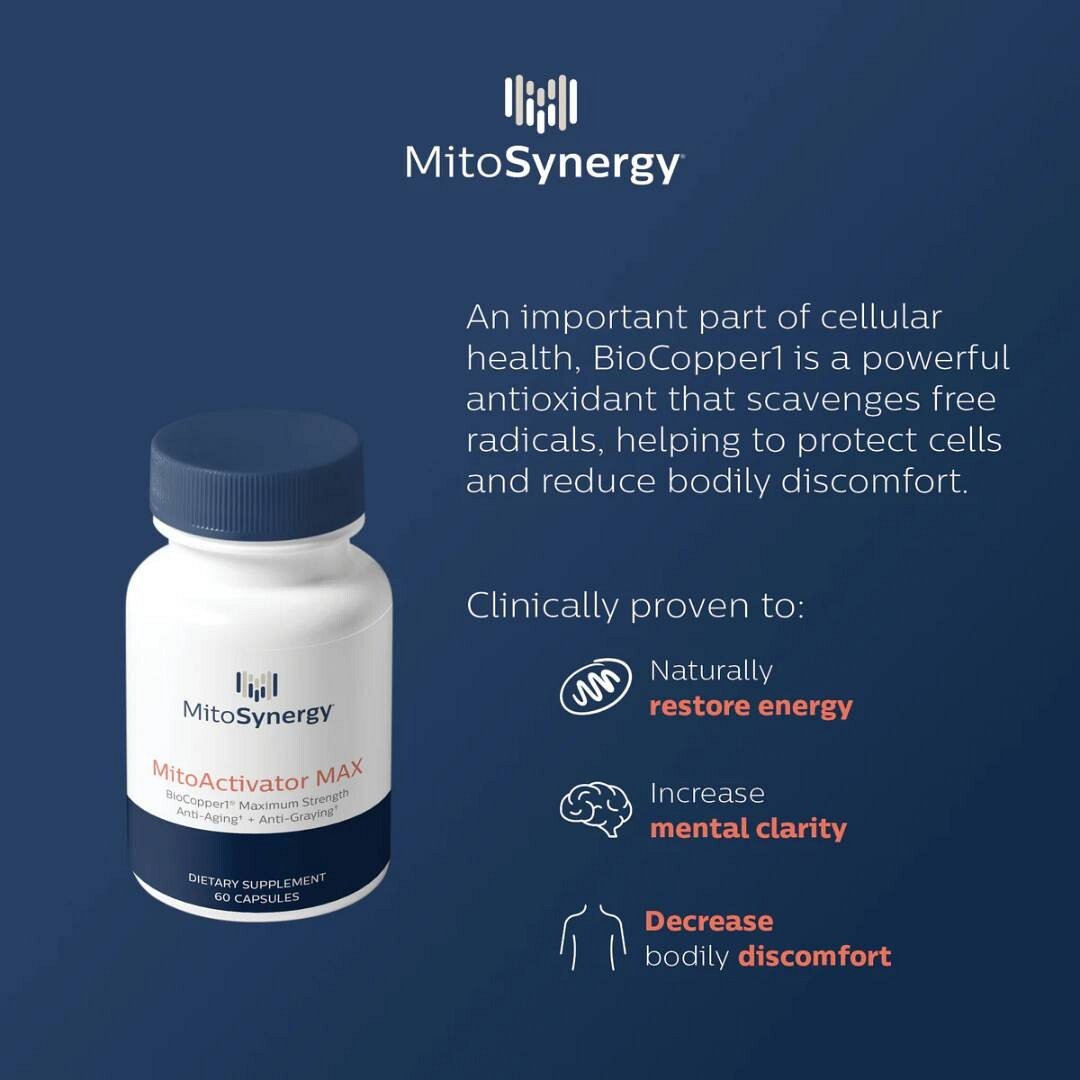
This is the part that’s getting a lot of attention, and MitoSynergy’s new MitoActivator MAX product is directly targeted at it.
Here’s the biology: copper activates tyrosinase, which is the key enzyme that converts tyrosine into melanin — the pigment in your hair. Melanocytes, the cells that produce this pigment, are extremely energy-hungry. They need well-functioning mitochondria to do their job. When mitochondrial function declines or bioavailable copper runs low, tyrosinase activity drops, melanin production falls, and hair goes grey.
Grey hair isn’t just cosmetic. It’s a canary in the coal mine. Your body is telling you that it’s prioritising essential functions — keeping your heart beating, your brain working, your organs functioning — and letting non-essential things like hair colour go. That’s a signal worth paying attention to.
MitoActivator MAX delivers 2.0mg of BioCopper1 per capsule — four times the dose of the EX that I’ve been taking. For people targeting grey hair reversal, MitoSynergy recommends 1 to 4 capsules daily (2-8mg). Their owner forgot to take his copper on a two-week vacation, came home with visible grey hair, went back on a high dose, and it disappeared within weeks.
Melissa was upfront: if you’ve been fully grey for decades, this probably won’t bring it back. But for people who are up to 20-30% grey, the results they’re seeing are encouraging. And it takes time — expect at least four months before you see new growth coming in at your natural colour. The hair has to go through its full growth cycle.
New Products Coming
MitoSynergy has a new product called Grow and Restore launching in the next two to three weeks. This is specifically formulated for hair — combining hair thickening support with grey hair restoration. It delivers a 10mg daily copper dose designed specifically for the melanin restoration pathway.
Following that, another product is in the pipeline that’s purely anti-grey — BioCopper1 combined with additional ingredients that support melanin production. So the product line is expanding from general mitochondrial support into targeted applications.
The Zinc-Copper Balance
This is important and we addressed it directly. Copper and zinc compete for the same intestinal transporters. If you take them together, zinc usually wins and the copper doesn’t get absorbed. MitoSynergy recommends taking copper and zinc at least four hours apart. If you can only manage two hours, that’s better than nothing, but four is the target.
When you increase your copper dose, increase your zinc proportionally as well. The balance matters.
Importantly, nobody taking MitoSynergy’s BioCopper1 — even at high doses — has come back with elevated copper levels on blood tests. Because the body knows what to do with Cu1+. It gets used, not stored. The copper toxicity issues that show up on blood work come from Cu2+ accumulation, which is a completely different situation.
Dosing Guide
MitoSynergy has products at different dose levels for a reason. For healthy people wanting athletic performance, energy, or grey hair support, you can likely start with the EX (0.5mg) or go straight to MAX (2.0mg).
For chronically ill people, those with mould toxicity, viral reactivation, or other complex conditions, start with the LDS product at 0.1mg per capsule. Take one capsule for three to five days. If nothing adverse happens, add another. Work up gradually. The LDS bottle has 90 capsules, giving plenty of room to titrate.
For autism families specifically, Melissa was emphatic: start low and slow. Most children on the spectrum are extremely sensitive. They can’t tell you how something is making them feel. Start with LDS, titrate up carefully, and watch for herxheimer-type detox reactions — headaches, irritability, fatigue — which are usually a sign it’s working but you may need to pull back and go slower.
Once you’re comfortable at five LDS capsules per day, that equals one EX capsule, and you can move up to the next product.
The Bigger Picture
The autism epidemic is real. Rates have gone from roughly one in thousands just 50 years ago to somewhere in the low 1 in 30s now, with boys affected disproportionately. Something in our environment is driving this, whether it’s glyphosate, other toxins, changes in the food chain, or a combination of factors. We can’t wait for every last clinical trial to be completed before we act.
As Melissa put it: the things that have actually worked for her son are the things insurance doesn’t pay for. The natural, anecdotal, not-yet-fully-studied interventions. That resonates with everything I’ve seen in my own practice and with my own mother’s health journey.
MitoSynergy’s BioCopper1 isn’t a cure for anything. But the science behind why bioavailable copper matters — for mitochondrial function, for Complex IV, for energy production, for myelination, for melanin synthesis — is robust and growing. And Melissa’s story with her son is a powerful reminder that sometimes the simplest interventions can make the biggest difference.
Melissa takes 8-10mg of BioCopper1 daily and hasn’t been sick in years. Her son has been on it since he was five. She’s not waiting for the final phase of the clinical trial. And honestly, neither am I.
WHERE TO FIND THE PRODUCTS:
Try MitoSynergy: mitosynergy.com/lisaTamati
LISTEN TO THE FULL EPISODE
Pushing the Limits Podcast: https://www.lisatamati.com/ptl-podcast/
Watch on YouTube: https://youtu.be/V0Vf7dMh8jc
MORE FROM LISA
Newsletter- Sign up for my longevity cheat sheet and weekly longevity news: www.lisatamati.com/lisa
Lisa’s supplement store: shop.lisatamati.com
Books: https://shop.lisatamati.com/collections/books
Aevum Labs (longevity supplements): aevumlabs.co.nz
Long Life Hyperbarics (New Plymouth): www.longlifehyperbarics.com
This blog post is based on a conversation on the Pushing the Limits podcast and reflects the personal experiences of the guest. It is not medical advice. Please consult your healthcare practitioner before starting any new supplement.