
Player not loading? Listen to the audio file directly.
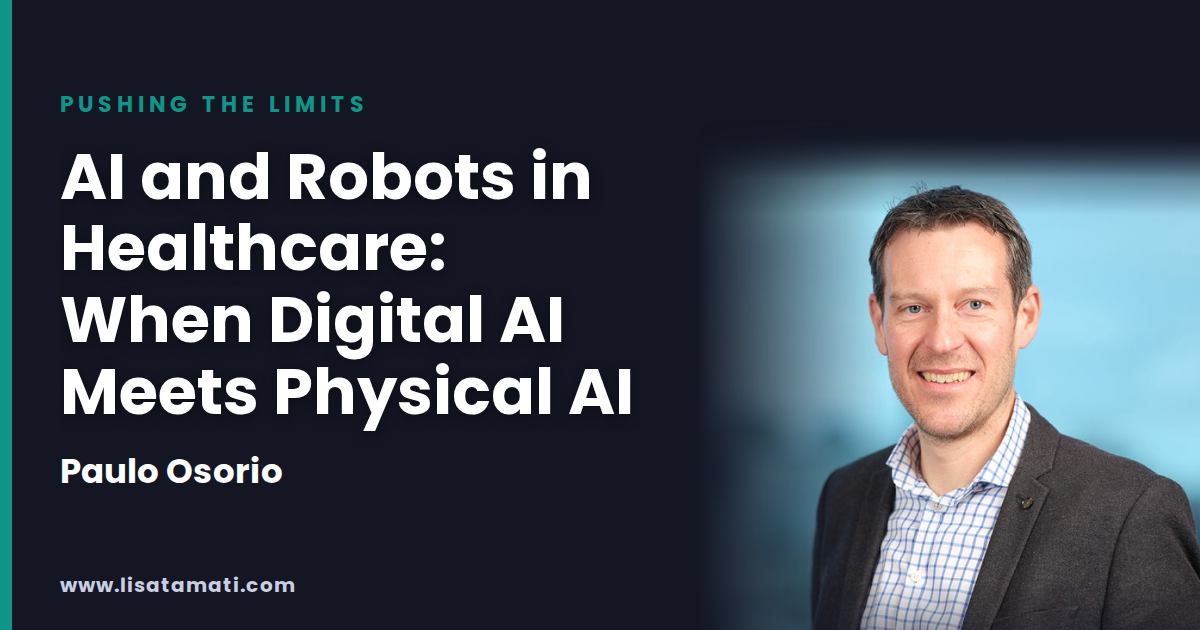
In this episode
Lisa sits down with Paulo Osorio of Deloitte to talk about how digital AI and physical AI could ease the pressure on health systems, with a focus on New Zealand. They cover connected health records, wearables and remote monitoring, and robots that take on the walking, lifting and carrying that fills so much of a health worker's day. Paulo explains why costs are falling, why he thinks pilots should start now, and what has to be sorted first: privacy, trust, governance and real-world training data. It's a hopeful, practical conversation about getting off the start line.
Key points
- Paulo Osorio believes a person's health record should follow them wherever they go. He says most countries don't have this connected data yet, and that it's the minimum people should expect.
- Paulo says that for around half the healthcare workforce, 30 to 40 percent of the work is physical: moving people, equipment and supplies. He believes physical AI and robotics could free skilled staff to focus on care.
- Paulo points out that physical AI isn't only humanoid robots. He believes smart watches, rings and remote patient monitoring, with AI watching the data, could help spot when someone needs help and when they should be left to sleep.
- Paulo believes the cost argument is shifting. He cites a 280-times fall in the price of AI inference and a Goldman Sachs estimate that humanoid manufacturing costs dropped 40 percent in a year. He stresses this is about giving staff capacity, not replacing them.
- Paulo is not asking for large-scale robot adoption straight away. He wants New Zealand to run pilots now and prepare, so it's near the front of the queue when the technology is ready. He suggests starting with non-patient-critical tasks like moving supplies, linen and rubbish.
- Paulo argues that pilots should measure cost per task completed as well as care measures like waiting times and clinical outcomes. He says privacy, trust and governance need to be worked out by policymakers, clinicians and technologists together.
- Paulo believes New Zealand's small size is an advantage, because the right people can be brought together quickly. He says robots need real-world healthcare training data, which creates room for partnerships with technology companies, and he notes that frontline staff are often the most supportive.
About the guest
Paulo Osorio works in technology and transformation at Deloitte, with about 30 years of experience in process, system, organisational and technology change. He describes himself as an adopted Kiwi.
Links
My mum's records didn't follow her. No one was watching. Digital and physical AI could fix both.
After six weeks fighting for my mum Isobel's life at her bedside, I went home to sleep for a few hours. She died while I was gone, alone, unable to press the button for help. Even when I pressed it, help often didn't come. Not because the staff didn't care, but because there weren't enough of them.
In this episode I sit down with Paulo Osorio, Partner, Deloitte Technology and Transformation, who leads Deloitte NZ's work on physical AI and robotics.
Paulo describes technology as one lever with two arms. Digital AI handles information: records, data and decisions. Physical AI does the physical work: moving, assisting and monitoring patients. My mum's story is what happens when both arms fail. Her history didn't follow her from Wellington to Taranaki, and there was no one in the room watching her. We talk about how the two arms need to work together, and why that connection could give New Zealand the healthcare capacity it can't hire its way to.
In this episode
- Digital AI vs physical AI, and why healthcare needs both - Monitoring, assistance, lifting and moving: the jobs robots can take on in hospitals - The robots already working in hospitals overseas - Why New Zealand could become a global proving ground - Privacy, safety and keeping humans in charge - Caring for a parent at home, and what it costs a family
This episode is dedicated to my mum, Isobel.
ABOUT PAULO Paulo is a Partner at Deloitte, focused on Technology & Transformation. He is an experienced leader in large-scale enterprise transformation, helping organisations turn strategy into action, and investment into value. Paulo leads Deloitte New Zealand's Physical AI and Robotics practice, working with organisations to define their ambition and translate exploration and experimentation into practical applications. He is passionate about the societal value Physical AI can create for New Zealand and its potential to improve the accessibility, capacity, and delivery of healthcare services.
Chapters (timed for this podcast version, which opens with Lisa's intro)
00:00 Introduction from Lisa 03:08 Why this episode is for Mum 08:01 Digital AI and physical AI 11:33 Beyond digital: the physical gap 12:56 Waiting, and who is watching 16:42 Connecting the dots 21:28 Robots in hospitals today 26:27 What will it cost? 28:32 New Zealand's advantage 32:23 Old buildings, new machines 36:40 Privacy, trust and keeping people in charge 38:24 Why the time is now 43:59 Where do we start? 47:11 Caring for Mum at home 49:36 A pilot that proves its worth 55:02 Getting off the start line 55:41 A proving ground for the world 1:00:04 Training robots with real hospital data 1:05:17 HealthX and the road ahead
LINKS Deloitte report, Physical AI: The moment of acceleration:
https://www.deloitte.com/nz/en/services/consulting/perspectives/physical-ai-acceleration.html
Connect with Paulo on LinkedIn: https://www.linkedin.com/in/paulo-osorio-4131202/
Pushing the Limits podcast: https://www.lisatamati.com/ptl-podcast/ Work with Lisa: https://www.lisatamati.com DNA Blueprint, your full genetic analysis with Lisa: https://www.lisatamati.com/dna/ Re:NRG and Re:juvenate Pro from Aevum Labs: https://aevumlabs.co.nz My Longevity Stack (free): https://www.lisatamati.com/lisa Shop: https://shop.lisatamati.com Instagram: https://www.instagram.com/lisatamati/
Read the full transcript
Made from the episode's captions and tidied up automatically, so the odd word may be off.
Lisa: Well, hi, everybody, and welcome into Pushing the Limits. Today I have my good friend, Paulo Osorio, with me. Welcome to the show, Paulo. You haven't been on before, but we've been on other things before, haven't we? But fantastic.
Paulo: We have, yeah. I've followed you for a long time.
Lisa: Yeah, like, and you are incredible, and you reached out to me actually, must have been over a year ago now, when I had Cern Basha on, our mutual friend in the States who's incredible, talking about robotics and technologies and AI and things like this. And we sort of connected on that. And, you know, since done a little bit of work with you and your team on webinars and things.
But we both have a very strong passion for what we're about to talk about. And this is basically about using AI, both physical AI and the digital side of AI, to improve our health care, putting it into a simple sentence. I wanted to actually dedicate this episode to my precious mum, who I lost recently, as my followers will know. They'll know that I looked after her for a very, very long time.
What happened to me and her in the health system really speaks to the problems that New Zealand health care is facing. She had an aneurysm, she was down in Wellington, and the care from the doctors and the teams, amazing. However, there were some major problems, and one of them is oversight and monitoring. There came a time where, you know, you're no longer in the ICU, you're no longer in the high dependency unit, even though she was critically ill, and the monitoring, basically at that level, stopped.
And my mum died alone in a hospital room after a six-week-long battle because I went home to sleep for a few hours because I was absolutely exhausted. She couldn't get help. She couldn't push a button. There was nothing to have any oversight. And, you know, I'd gotten her through three operations, three infections, had her back into rehab, and then the time that I let my guard down to go home for a few hours was the time she died.
For me, it feels unforgivable that I wasn't there. On the other hand, I'm human, and I need to sleep, and I need to be able to function. And I was coming in the next day to really fight for resources to try to get her access for an unsecured aneurysm in the gut. And this brings home the second problem that happened to her. There were many, to be honest, but this is the second major one.
We were shifted from Wellington Hospital to New Plymouth and it happened very quickly because they had the ambulance ready, and so the records did not come through properly. Half of them didn't come with her, and the people in New Plymouth were not informed that she had two unsecured aneurysms in the gut. And I was also unaware, even though I had power of attorney, I was unable to see the records, they wouldn't let me see them.
And so I was also unaware of the situation, the major situation. I only found out because I went through my indices, my local doctors, and I eventually found the records and saw that this was the problem. And I was going in on the very morning, on Friday, before she died, I was talking to the doctors, trying to get them to listen to see whether they could do something about the situation, and they said, oh, we'll have a talk at our meeting later on today, and we'll talk about it on Monday.
My mum never made Monday. This really brings home that if those records had come with her a few weeks earlier, if I'd had access to those, I would have been able to fight for those resources that she needed, you know. So this is personal, this is real, this is what you will be facing in the future if our health system doesn't get a helping hand.
And this is no critique on the people in the system, but the system is bursting at the seams where, as you know, Paulo, we have so many more older people coming through now and we have, you know, we've only hired another 56 nurses in the last two years and that's nowhere near enough, and the WHO has sort of released some statistics recently that's gone from really bad to extremely, extremely dire now.
We've got about 11.1 million healthcare worker shortage by 2030, which is just around the corner. I think when we spoke a year ago it was somewhere about eight million, now it's 11 million, and we are all chasing the same pool of international nurses and doctors and things that are coming from places like the Philippines and India, and, you know, we've been very blessed to have them come join us, but that pool is running short and everybody wants those people.
So with having said all that, give me your take, and you recently gave a big speech about this, so tell us your thoughts.
Paulo: Well, firstly, Lisa, I mean, your story you just outlined, the last few weeks or months with your mum, but I think actually you have a years-long history of caring for your mum and suffering in a way, you know, the shortages and constraints and the limits of what the health care system can provide. There's only so much capacity in the system to be able to provide care, and I think that's the heart that everyone should be slightly fearful about, because we could all face that problem, which is when we need the care, in whatever form it is, it might not be enough for us. And so I work in technology and transformation for Deloitte and I've been working in this field for 30 years doing process change, system change, organizational change and, you know, technology change along the way.
What really sparked my interest in physical AI and robotics was, and then applying it to the healthcare industry specifically, because there's, I mean, there's lots of other opportunities in other sectors, don't get me wrong. I mean, really, there's a fantastic opportunity. But what sparked my interest was really this convergence of AI as most people know it, and most people know it as digital AI. It's the ChatGPT, it's the AI search and retrieve and being useful and being productive and making us, you know, whether it's sorting your emails for you, you're now digital bots doing things for you. That's how 90% of people think about AI, as this sort of digital thing behind a screen being productive.
And that also applies in healthcare. There'll be an enormous uplift when digital AI permeates through the healthcare system. And you've just explained the connectivity of data between your record. Your record needs to follow you wherever you go, locationally, and you don't expect that your data record is in one location, but should you have an accident on a ski field in Christchurch or something that won't have your records. But the reality is they will not have your records. They won't know some of the things that you might be susceptible to, drugs that you might have a problem with. And that's not a New Zealand problem. This is a global problem. There's very, very few countries that have that connected data.
Lisa: It's crazy.
Paulo: It is. But most of us would expect that this will just get fixed, because we're used to connectivity of data and systems now. So I think this will happen, and there are plans for this to happen, and we must back them, because that's almost like the minimum that we really expect it, really is. It's a big step, and I am not a health care professional and every time I talk to people who work in health care I get a greater appreciation of the foundational infrastructure, if you like, that they are bumping into, that stops this kind of thing. So there's lots of pieces of this puzzle to put together from the ground up. However, I think there's a horizon where people's imagination somewhat stops, where they don't know what lies beyond that, and I think this is the part that I've been trying to educate folks on, because that digital enablement will only get so far.
I mean, in healthcare, you know, I think it's something like for half the workforce, like 30 to 40% of their work is physical, running around. Yeah, it really is. And it's so much movement of things, of people, of equipment. And so these are skilled people who should be on the front end of the care doing logistics. And because we're short of people, we need to look at physical AI and robotics to drive up that capacity and to stop it being a system that's constrained and limited where we all get used to waiting.
We all associate going to a hospital with waiting, and it's only because of the scarcity of resources.
Lisa: And people die when you're waiting. Literally, like in the waiting rooms and EDs around the country, people are dying waiting to be seen. And even when Mum first had the aneurysm, this three months ago, and she went in, it was 20 hours before we were able to get to Wellington, because again, we're a regional hospital, when all of those things have to happen in the background. They have to contact them.
They have to accept her, whether they're gonna take her on at all. Then you have to organize helicopters and you've got weather and you've got some things that you cannot control still. But the time that it took to get into surgery was far too long. And you see, you're just doing this waiting game, and then when you're in the system and you're fighting for the resources and you're fighting to get access to things, like, there isn't, I never, you know, I stayed there as long as I could stand up every single day, like I was, you know, trying to have a 24-hour vigil between me and my family going, but you know, after X amount of weeks, people have to go back to work, they have to, you know, and I'm left, you know, I was left standing there by myself a lot of the time, and you physically can't be there 24/7 because you fall over.
And I'm pretty frickin' determined to stay, you know, like, I'm, the exhaustion, all of that sort of stuff, as a human being, that, you know, that's where robotics in the future, and it's not too far away in the future, could be monitoring, could be helping, could be lifting, could be shifting, like the physical demand of caring for someone in my mum's position, who is 100% not able to do anything, not even lift a head up off the pillow.
You have to do everything for them all day, every day, you know, while they're trying to recuperate, and then you have to be super, super vigilant. The amount of times that I would ask, hey, I really think she's got a UTI or something like this, I want a test done, and it would just get lost. The nurse would go out, oh yes, I'll try and catch the doctor later to get the order for that.
That never happened. That never happened. That never happened 100 times a day. The questions that I had, because the doctor's off with someone else, and then they can't find them, and that nurse forgets, and so on and so forth. There's no, and so you're standing there, hey, I asked for this 18 hours ago. I still haven't got it. Oh, here. Oh, and there's a change of shift, and then there's a this, and then there's a that.
I resorted to things like going and getting urine dipsticks to put on the urine myself to show that she's got this thing, you know, this infection, in her case it was a really bad infection, and in our situation they were trying to push a palliative when actually it was an infection. This is a life and death situation and I was trying to get them to actually just do a test.
When the test came back and, you know, the horrible bug that she had, it was like, oh, well, we've got an answer for that, we
Lisa: Can put some antibiotics in, right? And then they did. And so she wasn't dying, you know what I mean? Like, this type of thing was going on all the time. And I see it in the other people that were around in the hospital and other, you know, over 11 years of being in this space, I've seen a lot of this. And a lot of people just die. And, you know, this is a multifaceted problem, but the monitoring, the heavy lifting, these are major things that physical AI and robotics can help with, and this is why I'm passionate about robotics and healthcare, and I've done, I don't know how many, four or five podcasts on it now. It's absolutely crucial that we have this conversation because I think what you were, Paulo, I was, the general public doesn't really realize how close this is and how this could really make a difference to your future loved ones when they're in hospital or at home eventually, you know.
Paulo: I think there's also a perception that this, and maybe it's because of the robotics part of it, that this is a little bit sci-fi and we all have visions of maybe negative of robotics. But that isn't actually the only form factor of physical AI. And you've just explained about the monitoring. And now, we all know that we've got smart watches, smart gear, smart rings, we've got these small, relatively, they're getting cheaper, these devices, which can monitor your health. For the folks that are actually in homes or in hospitals, there's ways to have them continuously monitored and have their systems connected, you know, remote patient monitoring.
Paulo: Now you just need to connect the dots here so that the intelligence and the AI can be looking at that data and predicting and foreseeing when someone actually needs help or intervention, and when they need to be woken up because they needed something, or when they should be left alone and actually left to sleep rather than, you know, and again, I get educated by healthcare professionals who explain to me how people in hospital often get disturbed when they're sleeping and resting, to be given the pills or something at that specific time, but really what they should be doing is continuing to sleep and resting. And so again, if you think about the efficiency in the system, there's nurses doing things or there's clinicians doing things that they don't even need to do, but they need to have the digital and physical AI supporting their decision making and workflows. So I think there's, I mean, that's a whole area of AI which can remove waste and inefficiency and be more precise around the type of intervention that's required when you are in care.
Paulo: But the robotics one I think is something that's really interesting because robots, automation, this has been around for donkey's years, right, in factories, in production plants and stuff. So people understand robotics or automation. But today it's like this convergence of technologies which make it also more powerful. So the eyes, the cameras that they put onto these things now can perceive the world at much, much greater detail.
Paulo: And then you've got the AI models and training models and inference models that can then use what the robots are seeing and infer the real world. Now, that wasn't possible a few years ago. You couldn't have a robot scan the room and ingest all that information and make sense of it. It had to be coded, it was slow, it was failing. But this is all possible, right?
Paulo: So, inferring the world works if you've got AI and you've got the training models. Then you've got the hardware of these robots, which again, the hardware, the engineering, the actuators, this stuff is going at a speed that's again far, far quicker than the past, and I think most people don't realize how adept these robots are going to be. I mean, it's a bit funny when we see them running marathons or doing judo or boxing and stuff, and that's for fun, but actually what it's really showing you is how nimble, fast and dexterous these pieces of equipment are. And so then you convert all this technology together and you've suddenly got the ability for something to be out in the real world, to see and perceive, to infer and reason, to make decisions in real time.
Paulo: It can be given instruction and parameters within which to work, and then it can do tasks which require dexterity. So each one of those advances in technology is going rapidly and it's converging into advanced robotics which is going to just be productive labor for us. Yeah. And whether it's moving food or linen or pharmacies or moving beds, moving people, moving anything in the healthcare system, this is going to be a massive unlock.
Lisa: Yep, and it's coming faster than we think, and already we already have things like Moxi Robot and Medtronic has got one as well. I think Moxi's in 25 or something hospitals in America. It's already done 1.25 million deliveries. It's saving per shift, a nurse per shift, half an hour currently, and that's a wheeled robot. We're not even getting to talking about the humanoid form of the robot.
Lisa: And I think, you know, the wheeled robots that can run around and deliver pharmaceuticals and deliver things and take the linen and put out the trash. Fantastic. I mean, that's a good place to start, but it is really only the start. When the brain, you know, when you have these really advanced robots, and there are, you know, there are dozens and dozens of companies now working at the cutting edge of these things.
Lisa: It's not just one company or anything. There's a whole lot working at different levels. But when you get within the next two years, we're really going to see massive changes coming. And then they'll start to be produced, you know, and start to be seen on the streets and seen out in the workplace. And I mean, a couple of years ago, I mean, people now traveling overseas to America, they can hop in a driverless car and get driven around.
Lisa: You've done that. That's a two-ton car hurtling through our environment. And it does it safer and better than we do. That's statistically true. And that's going to revolutionize transport. Now, you know, think about that then in the healthcare where you can have robots that are going to be able to, you know, if I had a robot that could have sat and monitored my mum and being connected to the blood pressure, the oxygen stats, temperature, you know, things like that that are very easy for a robot to do without even disturbing her, then we would have known if something happened, you know, and immediately they could have sounded their alarm, and in the case with my mum, you know, when she was dying and couldn't get help, could not push a button, you know, and the blood pressure would have been dropping because she bled, and so Dad would have picked that up.
Lisa: If a robot was sitting in that room monitoring her that whole time, I could have gone home to sleep without now feeling the guilt that I feel for being a human, you know. It's incredibly important, this stuff. This is not a theoretical thing that Paulo and I are talking about here. This is happening right now. Our systems are overrun right now. We have an opportunity to go right now and run pilots and run, you know, in New Zealand, we have the opportunity because we are a small English-speaking country that is no threat to any other country, no technological threat to perhaps attract, and we have to go proactively and approach these companies proactively as a nation and try to get a pilot done.
Lisa: That's the dream I would like to see, and I know you would like to see that too. We have to start there and then be able to scale it from a pilot right through the country. That's the sort of longer-term vision, and I think, you know, technologically it could happen now, but we don't, you know, we've got to, we've got to start where we are, you know, and getting people aware of it for a start.
Paulo: I mean, I'm just going to tell you something else. If I get into conversation about this, people say, oh, that's lovely, but actually, you know, the cost, the cost, the cost. Well, the reality is that the cost for these advanced robotics is falling every year significantly. So if you just think about what I was explaining before, I know you need the cameras, or you need the AI brain, which is compute, right?
Paulo: So the cost of the compute is falling dramatically, right? So I think, you know, orders of magnitude, there was a 280 times fall in the price of, you know, AI inference, right? And that's over like a couple of years. So where are we going to be in a couple of years' time from here to there? The cost of the compute that's required for this is going to be lower. The thing, it's like, let me get, yeah, that's right. So Goldman Sachs, just in one year, reduced the cost of manufacturing a humanoid robot by 40%.
Paulo: So they have a range of what a humanoid robot will cost. And in one year, they predicted that cost is falling by 40, 40%. So again, in two years' time, these pieces of technology that you think, oh, you know, we can't possibly deploy 10,000 of them in our healthcare system, well, actually, you will be able to save money. The cost equation will be there. And it is not about replacing human workers. No, because the workers that we're talking about here, there's still a significant portion of their work that actually is not really automatable. But we need to give them the capacity so that they're not doing the things which only the human can do. And the cost equation should not be, well, we'll just strip out workers and replace this with the bots.
Paulo: This might be true in some other industries where people are doing very mundane and laborious and physically demanding and safety-critical jobs, and there will be displacement of those jobs, and we'll need to move and transition those jobs to ones that are not, like we've done, you know, but the cost equation is moving towards the adoption of this. So the technology is moving forward at a rate of knots, the cost is becoming more favorable.
Lisa: The intelligence. The brain.
Paulo: Here in 2026, if you look at 2025's data, there weren't that many tens of thousands of robots, humanoid robots I'm talking about, manufactured in the world. But again, it's not a linear line, there's more and more humanoid robot manufacturers that are moving to scale. And that scale is not linear, it's exponential. So it's a real opportunity for those that can get prepared to be able to adopt these pieces of machinery and pieces of software and hardware, with this embodied hardware and software together.
Paulo: So, real opportunity. And like you said, if we bring it right down to a New Zealand context, we have a fabulous opportunity to pilot and then move to scale. And again, I'm talking just about healthcare. The difference between New Zealand and some other countries, of course, is that we've moved to a national system. We are connecting these fragmented district health board systems into a national system, and part of that digital AI transformation that we referred to at the beginning is helping to create, you know, digital connectivity across the landscape, whether you're in the rural areas, whether you're in the cities, wherever you are. And this is, I think, that change can't come fast enough, but it is moving and that's actually great to see.
Paulo: I think the healthcare leaders need to be recognized for the fact that they are indeed moving us forward and they want to go at pace. I'm going, that's great, but we've got another horizon. Yeah, she's got to deal with the shortage of hands in the system.
Lisa: Yep. And are you being heard there? Like on the robotic side? I
Lisa: Mean, we've got the digital that's really going ahead. It takes us time, but it's coming. But the physical stuff, are they getting that message? Are they understanding the implication of this?
Paulo: Oh, I think there's education that's required. And there's skepticism. But I do think there is recognition that this is coming. I think the difficulty is when you're putting out fires in your system in front of you, when you've got so many challenges in front of you on the day to day, and even on the first horizon, it can seem overwhelming. And it's like, yeah, we'll get to the future in the future.
Paulo: And so it's hard to do both. And I'm not advocating actually for scaled physical AI adoption in 2026 or 2027. It's the preparation for 2029-2030. By then, we will have those connected systems, we will have that connected data, but we'll still be short of hands. And if we start then and go, oh, well now we'll take physical AI seriously, it will take us another two, three, four, five years.
Paulo: And then we're down the line of countries lining up for these things and we're not going to be at the front of the line. And if we are, however, helpful to these companies in running pilots, because they need real world information, they need to train on real world things, not just in simulations. That puts us at the front of the queue, so am I thinking, and if we start negotiating with those companies now for what's coming in three, four years, then we're going to be at the front of the queue, not at the back of the queue.
Lisa: You know, it's always about, you know, being just like I do with health. I'm always about the preventative mindset, and that's the same thing here. We need to start the initial conversations, you know, and that's not easy. You and I've tried, you know, like we've reached out to certain places and tried to get conversations. It's not easy to get your foot in the door even now, let alone, you know, when everybody realizes how great and wonderful this is going to be, and everybody's rushing for the one door we might not be at the front of the queue then, you know, we have an opportunity now.
Paulo: Yeah. There's a couple of things. I think there's the work with those that are providing that technology. And again, I've been very clear around the fact that we can't take the path that is maybe open to other sectors where they can build a new warehouse or a factory, which is a clean slate and they can make it robot ready and it's very ordered and structured and you can sometimes see, you know, in these automated warehouses and distribution centers, it looks pristine. Now our healthcare system and our hospital system is not like that. Because we have these legacy buildings and they're going to stay with us for some time and we can't just go, I will build brand new robot ready hospitals. If we're building a new hospital we can do that, but we're still going to be left with our legacy hospital infrastructure. So these machines have to be intelligent enough to navigate the heroic scenes that are our wards, our corridors, our lifts, our doors, the stairs, all of which are different standards.
Paulo: But that's not a problem, that's just what they have to do. There's really nothing stopping pilots to just ensure that these machines can safely navigate these environments, you know, because you have to find your way around people and things and, you know, the obstacles of an environment which is somewhat chaotic. But this is precisely what physical AI and advanced robotics is there to do. And I'm not even talking about the far end of where this goes, which is physical AI assisted surgery.
Paulo: I mean, that's a whole another chapter and we could argue about, well, some people would argue that they don't want that to happen. But I'm just talking about the first horizon of physical AI, which is actually alleviating a lot of that logistics, the movement, you know, the work throws, where, yeah. So for New Zealand, we have to, I suppose, we've got two choices. We can watch and let others find their way and then we'll follow. But we'll be here for some time and we will still be living with the constraints of the system that you have personally experienced with your family. That's one choice.
Lisa: People will die. This will cost lives. This is not theoretical. This will be, you know, quality of care that we can provide, the lives that are lost because of the situation and the limitations that we have. And as we said, the shortage of stuff that is coming, that is not even here yet. Those are things that are coming. We do know that. We also know we have an aging population who's getting sicker. He's got an evil care. So we can see the tsunami coming, guys, on the horizon. We need to prepare the shoreline now. Yeah.
Paulo: There's the aging population, and it's also the aging workforce in healthcare, and the statistics on that I don't have them to hand, but the statistics are that the folks who have been working in healthcare have been working there for some time, they're, you know, they're going to be coming off, you know, into retirement age very quickly, and the entrance into the system is a problem as well. And this week actually I spoke to some teachers and they were talking about the fact that a lot of their brightest pupils want to get into medicine and health care but they don't want to do it in New Zealand.
Paulo: I mean, what a terrible, these are our brightest and smartest, they actually want to contribute to this amazing sector but they can see the system in front of them in New Zealand and don't want to be a part of it. Now, I want to turn that on its head and go, if we innovate, if we take the risk, which has got enormous upside, there's virtually no downside actually, there's no downside to preparing for a robot future where the cost of things is manageable.
Paulo: You know, we're not talking here about just having really expensive equipment, but you've got to do the preparation and the preparation is not as easy. It's not like switching on the software, which you can then switch on and switch off. There's privacy data and privacy issues, there's trust issues, there's, you know, there's governance about what they can and can't do. Now, all of those individual hurdles need to be resolved.
Paulo: And they will take time. And they will require policymakers, healthcare leaders, politicians, technologists and clinicians and the heads of clinical staff coming together and working this out so that you can put physical machines into environments which see people and identify those people. So that's the sharing of the record and suddenly people are starting already to get nervous about, why, I don't want that robot seeing who I am and then having access to my data.
Paulo: But actually, what we need is strong closed loop, secure data and control of AI. If we can crack that, and there's no reason why we can't. In fact, in New Zealand, I think it's much easier to get these people together because we're such a small country, like to get policy makers, politicians, heads of health care, technologists, the people who look at cyber and security. These people are within the same city.
Paulo: We can get them together and then we can agree on pilots and we can agree on measurements of success and get ourselves ready for when we want to do this at scale. It's easier in New Zealand than it is in the US, in the UK, in Europe, in any other country.
Lisa: Yeah, totally. And we're a democracy, we're small, we're not a threat to anybody, so we're not going to be problematic on the world stage if a pilot... I mean, when I was a teenager, we had the first fiber optic cables and, you know, F postcards and stuff, I'm really showing my age now, but you know, we were at the forefront back then, and now then we've fallen off the forefront.
Lisa: This is a chance to get back on the forefront too. And these are serious issues that you've raised, privacy, security, safety, these are machines, you know, that we have worked in with this type of thing before, you know, like, we've just got to come up with the ways of doing that in a safer environment. And I think that the humanoid form factor, if you like, people equate that with the science fiction of the past and all those movies.
Lisa: I know Peter Diamandis on Moonshots is trying to get out some movies about positive things that AI and robotics can do in the next generation of sci-fi movies, because it does have a massive influence on the psyche of humanity when you see R2-D2 and C-3PO, now I'm really showing how old I am, is positive sort of things, or Star Trek that's positive versus the Terminator and things like that.
Lisa: And I think that's in the underlying subconscious of people, is that fear of, but at the end of the day, these are machines, they are not conscious. I do not prescribe to any of that stuff with AI. These are things that we can use, and they do need controls, obviously, we need to have very robust discussions around safety control, privacy, who supplies the robots, which countries, all of that sort of stuff.
Lisa: But these are not insurmountable. What is insurmountable is the amount of sick people we're going to have in the future that aren't going to get care, and so the urgency for these difficult discussions is now, so that we can actually, you know, get on with the job of improving our future health for it. And, you know, I mean, on the other flip side, I'm excited for all the longevity and breakthroughs in science that AI is bringing, in the new drug discoveries and the new supplement discoveries and things. That AI is just unbelievable, what it's doing, you know, like in, and again, I'd like to see New Zealand be at the forefront of getting some of this and adopting some of this and, you know, I've belabored the fact for over a decade now that we can't get access to a lot of the cutting edge stuff already, let alone what's coming now.
Lisa: So, you know, we have a bright future if we choose to embrace this in a positive manner, with a positive mindset and have goodwill amongst the leaders of our country and our health care and stuff to actually, yeah, we've got problems, there's things to tackle, there's policies to work out, there's safety, there's all of this thing, but let's go for it, let's try a pilot in a controlled environment and then go from there. And these things just take years, and that's why the window is now. The window of opportunity for New Zealand is now and we've got to move, and we're going to move pretty fast to get the ball rolling, you know, there'll be hiccups, but we have to get rolling.
Paulo: Yeah, and we've also, the whole sector in New Zealand can be set up for this as well, so everything from universities and research institutes, and who can do, you know, if we can link them up to, you know, challenges and problems within the healthcare industry, link them up to using technology providers who provide investment. This is the pathway to scale, right, because it's going to be easier to do a controlled pilot and work through the niggles, work through the issues, whether that be about the safety, the privacy, the trust.
Paulo: But like the evidence at the moment suggests that the people who are most for it are the frontline staff. So this is not about the technology department pushing new technology onto clinical staff who are like, oh, here's IT or whatever, pushing us to do something new. You've got to get those scarce workers who are highly valued into the loop because actually it's for them and then it results in better care for the patient.
Paulo: If you start that way, you will get massive adoption and I think this is the thing that, I've been in technology for a long time,
Paulo: If you push the technology onto people, often you get adoption resistance. But you only have to go and talk to folks on the front line and they will tell you that they are exhausted from walking so much, that they're having to do laborious tasks, that they're annoyed that certain things happen only once a day or twice a day. And it's like, why? Oh, because this delivery only happens once or twice a day. And it's like, well, why isn't the robot shuttling continuously? It doesn't take a lot of imagination to go and find the problems. If you recognize scarcity and limits, then you are discovering where physical AI and robotics can help.
Paulo: We can start on some fairly non-frontline clinical use cases. Yeah,
Lisa: Just for us then, where do we start? Because we can't start in the neurosurgical world, more of wanting to. Like, we probably need to start somewhere more basic that's not going to interrupt the current flow. But
Paulo: That's where, yeah, I think a lot of that is happening in the US with Diligent and their Moxi robot, with Cobalt, where they're doing a lot of transportation of supplies, medicine, food, lean in records, and just alleviating the staff from having to go backwards and forwards, up and down, doing many miles. But the cleaning, the disposal of rubbish, it sounds fairly mundane, but this is the first step to then going, well, if I can do that, then I can do the other, and then I can do the other. The trend will be that there'll be more hospital in the home and care in the community.
Paulo: That's going to be…
Lisa: Amazing. Yeah.
Paulo: Yeah. And quite rightly, we don't want people who needn't be in hospitals being in hospitals, but being cared for at home. But there's another issue there, which is if you push them at home and they're not getting care, then they're going to suffer relapses and problems. So, yeah, we've got to get the technology to work appropriately in the home. Now that's a fairly connected and lengthy discussion about how we can do that.
Paulo: But transporting people to and from care facilities to home is also really important. You know, some of these people who are aged find it difficult to transport themselves. But what if we could actually have abundant transportation at low costs as well, which is perfectly within our means to do in two to three to four years? We should be demanding that we have abundant transportation and we're not constrained by that.
Paulo: The care workers who go to visit people's homes, and then they look after the individual but also are doing clean up and cooking, or they can take along with them a robot assistant. This is the…
Lisa: Abundant future that we're looking at.
Paulo: Now, some of this will seem pie in the sky, but it isn't. If you follow the crumbs of how one will lead to the other, to the other, to the other, you can see a point where we shouldn't expect constraints and limits and waiting in our system. And I think that's the bright, abundant future we've got to target. We're not going to get there in one jump, but we've got to make the moves to be there in 10 years, 15 years.
Lisa: Yeah, and being able to care, like, you know, with Mum, I was able to care for her for 10 years. The cost to me was enormous: the stress, the, you know, the sleep deprivation, the, you know, huge toll on the marriage, on the house, on the finances, on the business, you know. And I'm luckily in the position of being able to work like this remotely and do things remotely, so I could do that.
Lisa: No, most people aren't. You don't want to put your loved ones somewhere where they don't want to be, right? You want to have them where they are in their home. They're comfortable, they're supported, they're surrounded by their things and their people. And when it comes time to die, you want to die at home. Everybody you ask wants to die at home. Nobody wants to die in a hospital. And, you know, that's another tragedy that we could, if we could provide care in those last weeks of, you know, in-home support, around the clock care without having to bankrupt the family. Because, you know, when I was in this situation, with Mum, many times, where I was trying to get caregivers, and it was like 1,500 dollars a day, you know, just to get one caregiver, and I couldn't afford that.
Lisa: Yeah. And so I didn't, you know, so it was me, you know, and that, you know, the huge cost to people, the huge cost to society. Then that generation can't work properly, you know, or they have to put them somewhere where they know they're not getting the best care, because there's still a lack of staff and a lack of everything else, you know. And this is not talking about the people being bad or this, you know, this is just talking about pure resources.
Lisa: If I had, you know, had to put Mum into a home after the thing that she went through, because she was too high a need, she was not going to get the level of care that I would want for her. I knew that. And I would have had to be there all day every day for the rest of her life anyway. You know, there's just levels here that we can start, but let's start small, start in one place. Have you got somewhere in mind, like a particular hospital, a particular thing that you've got your mind heading towards?
Paulo: I mean, it's not so much whether there's a single hospital, but it's about applying a relatively simple use case, and then getting those stakeholders aligned to what success looks like. So even the pilot, in my view, needs to show a return on investment. And I think that one of the measurements that I don't think they're doing in healthcare is the cost per task completion.
Paulo: So, you know, so fine. Okay, the robots can move this stuff around. But what's the cost of actually completing that task? Because if you can actually measure, you can have metrics like this, and then you can scale them, suddenly it's very easy to write business cases. And it's suddenly easy to put those in front of decision makers who will have a hundred choices to make around where to put investment money, because there's so much to do, right?
Paulo: So this can't be seen as nice to have or, you know, with our spare money, which they don't have. It needs to show eternal investment. It needs to be measured and have metrics behind it. But the metrics have to also be around, not just about costs, but about care metrics. Because actually, that's the metric. It's the waiting times, it's the clinical outcomes and the clinical metrics. And so I'm not underestimating that it's hard to pull together the people that will have skepticism about this.
Paulo: They'll be legal, the cyber, the security, the data, the clinical things, and then they're the technologists. And it's going to be challenging to pull these people together and break down the barriers to making this happen, but it's very possible. It really is possible. And then you need to drop this into the correct environment. At the moment, because, you know, in some hospitals at the moment they don't even have Wi-Fi inside the hospital infrastructure, or there's dead spots.
Paulo: And you might go, well, why does that matter? It will matter.
Lisa: If they…
Paulo: Need connectivity, then that might be something. So when I talked earlier about digital foundations and the infrastructure, I'm talking about there are some basic things that need to happen first. But I see those, they're not solved, but the pathway to them is being solved by projects and initiatives and programs that are underway and are in the plan. They have to happen, and that will enable scaled robotics.
Paulo: But in the meantime we should be doing pilots, getting those trust issues, getting those policies rewritten, putting the guardrails, getting the human governance in the loop so that we're not deploying technology in unsafe environments or there's any issues in that. So you have to create a little mini ecosystem within the system. Pick…
Lisa: Somewhere and see if we can at least capacity, eliminate waste there, get the processes working, prove that we're saving costs and all of that. And keeping that North Star, I think, you know, this is the one thing: if we all have the same North Star, how we get there, and our opinions on how we get there, will be different. But if we keep it at North Star, is to save lives, provide better care, to have the world's leading healthcare system. Then, and when you all, each one of you listening, put it into your own family context.
Lisa: Your own personal context of the healthcare system you want to be in if you are so unfortunate to have to be there. That is a North Star for every single one of us as human beings. None of us want to have a system that is broken, stretched to capacity or over capacity and failing, and then there's stupid things, you know, like records not following people, and people dying because of it, or people dying in waiting rooms, or, you know, basic things.
Lisa: So there's just so much upside. There's just so much upside if we can keep that North Star in front of our head and tackle each of the, you know, you and I both like running, both run long stupid distances or have done. Just the same way you tackle an ultramarathon, right? It's terrifically long, you know, could be 50 kilometers, could be 200, 300 kilometers, whatever. And you're like, oh my god, your brain is just like, how am I going to get through this?
Lisa: And then you start the training program and you go, have to tweak here and improve here, and you get stronger, and you put in a better diet, and you tweak your training, and then you get to the start line and then you're like, right, now we're in it, and we're going…
Paulo: Well, yeah, well, you won't finish it if you don't start it, and I think we have to get off the start line. Yeah, and we know that that road is going to be hard and it's going to be full of obstacles and resistance, but the prize is really worth going for. Yeah. And like you said earlier, I think you said, the time is now.
Paulo: And the opportunity for New Zealand is to get a little bit ahead of the game here, because actually there's other markets that want to do the same. They have the same sort of challenges. But we can attract investment, we can attract those that want to prove this for their own, you know, competitive edge. So the marriage of us needing what they're selling and then wanting to invest to prove that they can sell on the global scale.
Paulo: There is an opportunity here. And, you know, the Kiwis, I'm an adopted Kiwi, but the Kiwis do have that ingenuity and risk-taking approach. We still have that, but it mustn't be risk in the sense of patient risk or, you know, we're not talking about that kind of risk. We're talking about being bold enough to start the journey and being on the forefront as opposed to going, well, we'll wait 10 years and then let's see how it's being done in the US or Australia or somewhere else in the world, and then we'll follow them, because all that will happen is that we will continue to suffer.
Paulo: And that, as we said again, the environment for us to be innovative, to do pilots of small scale affordably with staff that are going to be hungry for this, and the regulatory environment is actually quite favorable here. We have regulation to get through and
Paulo: The standards are being set for some of these things. But putting those people together and forming the rules, the regulations, the processes, the guardrails, as I said before, this is all achievable. Those things are not unachievable. And then the technology is going to come. We know the technology is going to come.
Lisa: Yeah.
Paulo: So the convergence of these two could be a very powerful force for New Zealand. And
Lisa: I think the other thing is, when you are an early-stage adopter, you get to the front of the queue. You've got some disadvantages in being an early adopter, and you and I are very much early adopters in everything we do. You're in the technology space, and I'm, you know, adopting as much technology and AI and medical breakthroughs as I can, and, you know, always at the carving edge of learning and trying to stay ahead.
Lisa: When you're an early doctor, you have to go sometimes back to the drawing board because it didn't work, but you're also at the front of the queue. I think this is really important, the piece of developing relationships with these companies to get the first robots off the lot, so to speak. Because once they start to go, and when other countries get in front of us, and companies get in front of us, then we won't have a show.
Lisa: Because there's going to be, you know, there's one company, for example, just right now, doing a million robots in the next year. And then they've got a million-robot, you know, facility that is coming online and going to be producing those. They're going to be all pre-styled before they even get out the door. You're going to have a years-long waiting list for these already.
Lisa: So if we can snag a small pilot trial with these robots, then we will have a good relationship with those companies and hopefully can get to the front of the line instead of being right at the back of the line. I think that's an important consideration for you. Funny analogy, but when I'm working, I want to get podcast guests on the show, right? And if I can get someone who I can see is going to be a superstar before they become a superstar, then it's a sweet spot, because they're willing to come on the smaller shows.
Lisa: Well, when they're too big a star, they like, pause it with you, right? But if you've had some stars, but I catch them early, often in their place, right? Because then they become the superstar, but I can see that they were going to be a superstar, right? And so I grabbed them early, before the demand went through the roof, and then I have a relationship with them. So maybe I can get them back, you know, despite not being the Diary of a CEO or something, you know, or Moonshots.
Lisa: That little business mentality, if you like, of that strategy is relevant for us as New Zealand as well, because we need to go first and fast.
Paulo: Again, I think people misunderstand how this is actually going to work. These generalist robots, these human-like robots, need training to do things. I think if you speak to people, they go, they're being trained off videos and they're going to be working in sort of robot gymnasiums, and they're going to have sort of specialized areas where they can train on doing tasks and handling objects and picking up glasses or, you know, moving things around. And they're supplementing these kind of robot gymnasiums with simulations, so you can actually take a task and then you can use it and then you can sort of create a thousand versions of it. So then the robot can see the same task in a thousand variations, and it's basically a supercharged way of upskilling.
Paulo: In the human world it takes a blooming long time from when we're born to when we can do something useful. It's years and years and years, you know, because of our, you know. In the robot world they'll get from out of production to having skills, you know, almost instantaneously through training. And this will be important for lots of tasks in factories, in areas, in controlled environments.
Paulo: It's when they are coming into what I call the real world, the chaotic world that we move and bounce around in, that it becomes a little bit harder. And in healthcare, there are going to be certain tasks which are very healthcare specific, and there really isn't that training data available to the technology companies. They're going to need to rely on healthcare providers giving them training data so that they can then use that to train their robots.
Paulo: Now, the question is, where is that going to come from? Is it going to come from US hospitals, or is it going to come from China hospitals? And so again, there is this opportunity for alliances and partnering to help this sort of flywheel of exchange of data for training purposes, so that the robots get more and more adept in healthcare and clinical settings. So, you know, turning a bed, that's not a task that I know how to do in a hustle setting, but it's not something that's easily trainable without real data, but it'd be fantastic if the robots could turn beds.
Paulo: So they're going to need videos, and they're going to need that so they can run simulations. And that's where alliances between healthcare providers and technology companies can be mutually beneficial, because in exchange for the data, they can get forward deployment. And again, if you start with things that are not going to be patient critical, you iron that out and you go, aha, if it works there, then we do another one and another one and another one.
Paulo: And you can isolate dozens, hundreds of single healthcare-specific use case types of things that you could give in exchange to companies who can train their bots on this and get this going. And I think that that's underestimated in terms of the value of this alliance and partnering with
Lisa: That's exactly, I mean, in that interview with Cern Basher that I did, he was talking about if we had, say, 25 to 30 robots, maybe up to 40, I think he said, within six months that would be the equivalent of 25 years of training of a human, and then instantaneously across the entire fleet. So within six months of 30 to 40 robots, you could have millions of 25-year-olds ready to go, you know, and to be deployed.
Lisa: That's the beauty of it. They don't have to train each one individually. There's something called fleet learning. Once you teach one, you've taught them all, you know. And therefore this is where the real world, and I listened to another expert on, you know, teaching the robots, and simulations are not, I've forgotten his name, but the simulations could get them so far, but they actually need to go out into the real world and get that real-world data, bring that back and then teach the fleet. Because, yeah, and this is again where we, as a small country with a pilot trial, could be that, you know, for them, providing them that information that they can really then use, that real-world information. Because like you say, in the States it's really hard from a legal point of view and all the rest of it, the regulatory stuff, to get through, whereas in New Zealand you've got a willingness from the people at the top of the health system, actually, to actually entertain the idea and to get this through, and therein lies the advantage of being a. So we've got to leverage the advantages of being a smaller country at the same time as being aware of the limitations of being a small country.
Lisa: Yeah. Yeah.
Paulo: And I've got to say, I mean, there's a division within Health New Zealand called Health X, and they are running a series of AI initiatives successfully that are having returns. Maybe not so much in the physical AI space, but actually they're incubating ideas and then they're scaling them out. And this is a successful formula. So what I'm talking about is plugging into the sort of formula that is already there in terms of pilot scale.
Paulo: And with control, with governance, with the right stakeholders involved, like all of those things, we're not shortcutting any of that. But yeah, that convergence of the technology, the cost coming down, and then us getting ourselves organized to be ready to deploy.
Lisa: It's new. It's optimistic
Paulo: in a sector which often doesn't seem like an optimistic sector because of the challenges and the constraints.
Lisa: Yeah, and so this is just super exciting. To wind it up, I mean, hats off to you, because you've got to get this enthusiasm that we both feel across to key stakeholders and get them to see that abundance mindset that we both have for technology and for the things that could come, and realizing the limitations that we currently have, and just, you know, we have to go for it.
Lisa: There is a cost to waiting, just like there is a cost to, you know, people are worried about safety and things like that. People will die if we don't do anything as well. So you always have to weigh these things up. I mean, you know, with self-driving cars and, you know, the whole FSD and all of that, the statistics are now showing that the fully self-driven cars that are run automatically are far safer.
Lisa: We're going to be, pretty soon, 10x or something safer than the average human, is what I've been told. I haven't verified that number, but 10x safer. Then in future it's going to be, why would you drive, you know? And then the productivity unlock from that, when I don't have to drive, my car drives me, and when I'm stuck in traffic for an hour, I can actually do work and things like that.
Lisa: So this feature is here right now. So just to wrap it up, Paul, again, hats off to you and your team for what you're trying to achieve here. And I'm 100% in behind you, whatever I can do to make this happen and to get the ball rolling and to get people listening, so that precious people like my mum can in future benefit from an improved system and not be the victims of the situation, you know, as we were.
Paulo: And hats off to you, Lisa, as well. You're a pioneer here in this area, and I think bringing your personal story makes it very authentic. I am in total admiration for what you've managed to do over the years in balancing your business and your care for your mother, and I think it was your passion that led me to reach out to you, because I think we had a common goal.
Paulo: Coming at it from different perspectives, me from really a technology angle, because I'm working in Deloitte, working with organisations that are making change, and you coming at it really from the health
Lisa: field and
Paulo: care sector. But the convergence of this is real, and I think we just want to, we want this for our own future, selfishly, and we want it for the wider organization.
Lisa: For our country. Great. Is that the drop-the-mic moment right there, Paulo? I can't wait to help be involved in any way I can, and thank you so much for your time today, Paulo, and your passion for bringing this to fruition and getting the ball rolling. Let's hope that conversations like this get out into the world and we can spread them and just start having open conversations about the challenges that it does present and also the opportunities, and keep that abundance mindset in your head and keep that north star of a better health system that you would be happy to be in if you have to be in that situation.
Lisa: And we will all be there one day, you know, so thanks for all that. Fantastic.
Follow Pushing the Limits